
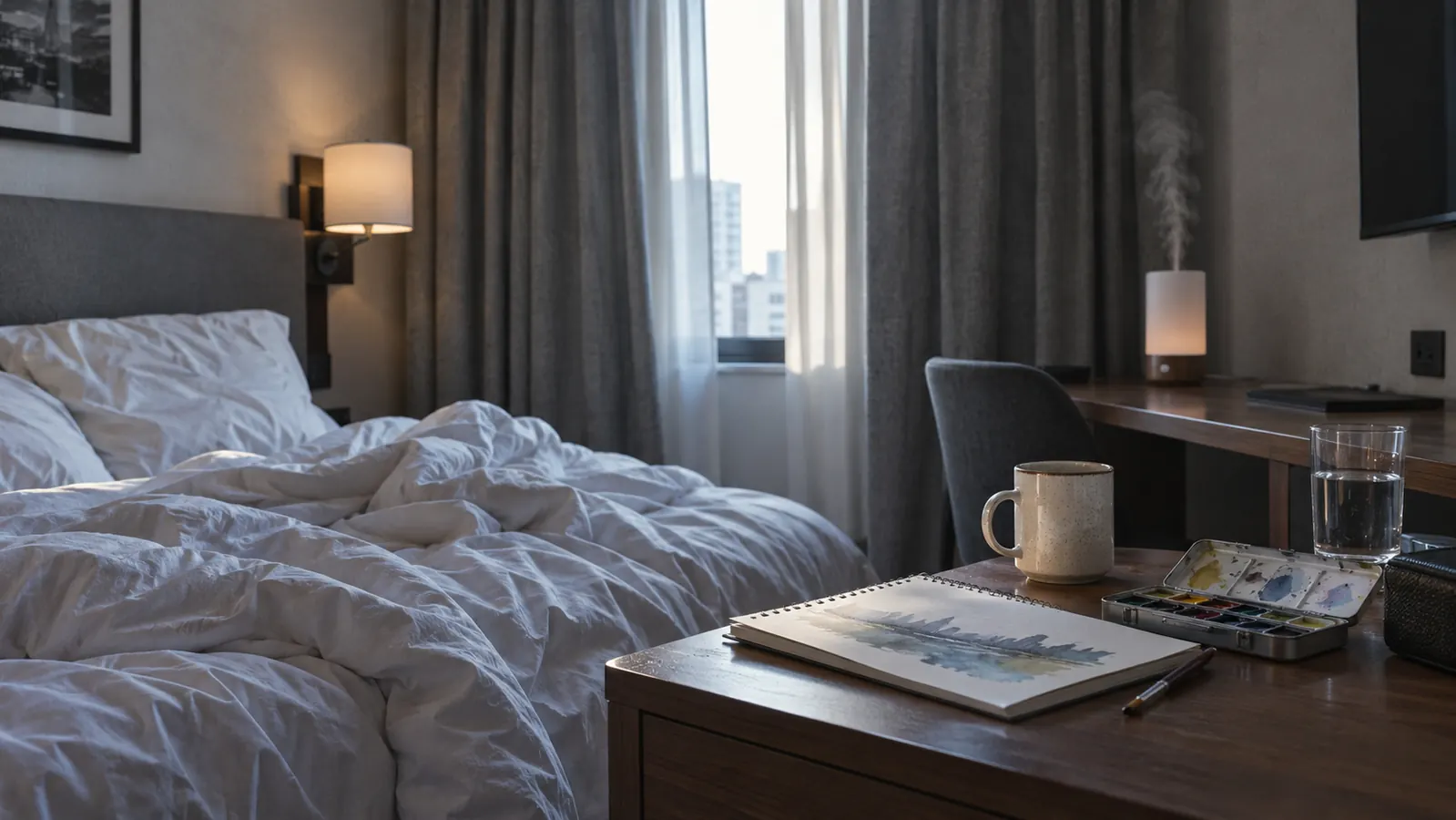
The first night in an unfamiliar room is the part of travel nobody photographs. I am Iris Vandermeer, sixty-one, a retired high school art teacher from Asheville, North Carolina, and I spend a good part of every year driving my 2019 Subaru Outback to state parks to paint. The bed is usually fine. The light is often lovely. But the room smells like a photocopier, the air does not move, and I lie awake at two in the morning with a stiff neck, listening to a fan I cannot turn down.
A cardboard air freshener does not fix that. Neither does opening the window onto a parking lot. What fixed it for me was a small piece of gear I now pack before my brushes: the URPOWER waterless essential oil diffuser, a cordless unit that runs on a battery and puts a scent I actually chose into a space I do not control. It has gone with me on every road trip and every flight to Tucson to see my sister since. My husband Walt stays home with the garden and the cat next door, so it is just me, the car, and whatever room I land in. Here is exactly how I use it, step by step.
Start with the one that runs on a battery instead of a wall outlet
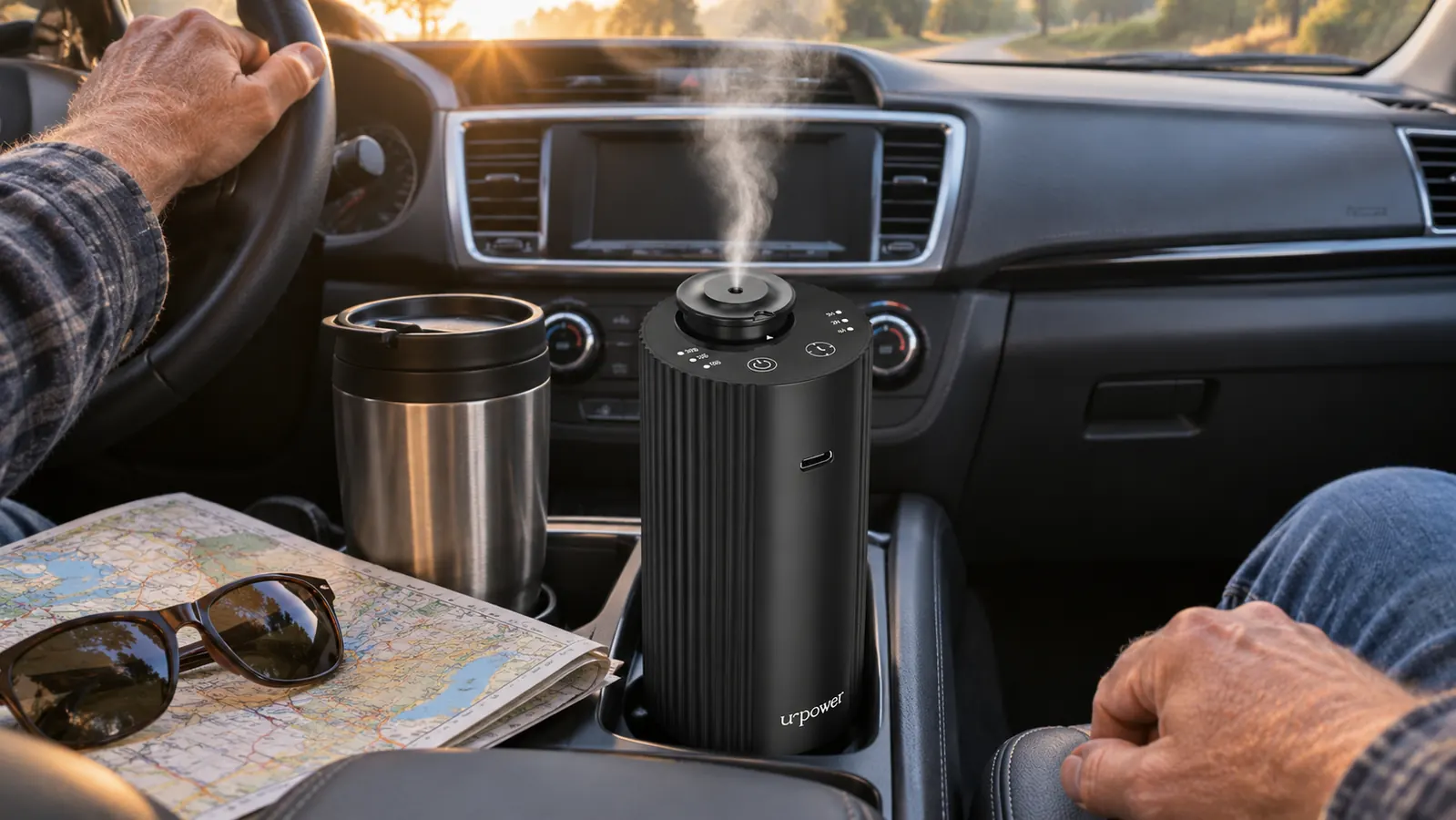
The URPOWER waterless diffuser is cordless, rated for up to 48 hours of runtime on the Eco setting, and rated to cover 600 square feet. It ships with two 20 ml hotel style fragrance oils and a USB cable. At 0.51 kg and 4.7 inches tall, it lives in the travel bag without a fight.
Amazon Check Today's Price on Amazon →Five Steps, in the Order I Actually Do Them
Step 1: Choose the scent at home, not in a hotel lobby
The set arrives with two 20 ml bottles, one citrus green fruity floral and one fruity floral ambery woody, both built to smell like the lobby of a hotel that costs more than the one I usually book. They are stronger than they look. The first time I opened one I dabbed a little on a tissue, set it on the kitchen counter, and left the room for twenty minutes. When I came back I knew exactly how much was too much, and I learned it in my own kitchen instead of at eleven at night in a room I had already paid for.
That is the whole test. Run the diffuser in a room at home for an hour, leave, come back, and pay attention to your own face when you walk in. If you flinch, that scent is going to be a problem for eight hours. If you barely notice it, that is the one to pack for sleeping. I did this in my studio in early March, with the window shut and the door closed, and wrote a line on an index card about each bottle. The citrus one I marked light and the woody one I marked for evening. Those two cards are still folded in the case.
The other thing worth knowing is that these are oils, not perfume. The unit is waterless, so there is no reservoir of water diluting anything, and 20 ml goes a long way because the diffuser sips rather than pours. I have never finished a bottle in a season of travel, and I have never had a bottle leak in a suitcase, which is more than I can say for the shampoo.
Step 2: Charge it before you leave, and pack the cable anyway
The diffuser charges over USB-C and takes three to four hours to fill up. That is a job for the night before you leave, not for a hotel room at midnight with the only outlet hidden behind a mattress. A full charge is rated at up to 48 hours on the Eco setting. On a two week road trip I charge the URPOWER once at home and once at my sister's kitchen counter in Tucson, and that is the entire charging story. I plug it in beside the kettle while we eat dinner and it is finished before the dishes are.
Pack the cable regardless. Hotel outlets hide, and a dead diffuser on night three is a small sadness I have arranged for myself before. That happened in a motel outside Boone in October, where the only free outlet was behind the dresser and I had left the cable on the hall table at home. I spent the evening with the window cracked instead. At half a kilogram it is light enough to live in the canvas bag with the sketchbooks, and small enough that I forget it is in there until I need it. The body is aluminum, 2.7 inches across and 4.7 inches tall, so it does not fight the watercolor tin for space.
Step 3: Put it where the mist reaches you, not the ceiling
The unit is rated for 600 square feet. Most hotel rooms are smaller than that, which means placement matters more than power. I set it on the desk or the nightstand at roughly shoulder height when I am sitting up in bed, and I keep it out from directly under the air conditioning vent. Scent that goes straight into a vent goes straight out of the room, and you end up turning the setting up to compensate.
Do not put it on the pillow or on the folded towel at the foot of the bed. The body is cylindrical and it will roll if you knock it, so a flat surface with a little room around it is the right home. I set it on the far corner of the desk with the mist pointed across the room rather than at my face, which also keeps it out of the way when I get up in the dark. In a room with a long counter under the television, I put it at the end nearest the bed for the same reason.
One small hotel habit that made a bigger difference than I expected: close the bathroom door. A good share of the square footage in a typical room is behind that door, and if it stands open the scent has to fill both spaces before it reaches you. Close it, let the sleeping side of the room fill, and leave the bathroom to its own air. I also drape a towel along the bottom of the hallway door when the gap is wide, which is a trick from my mother and has nothing to do with fragrance and everything to do with the light and the noise from the corridor.
Boost Mode runs 30 seconds on and 60 seconds off. An hour of that when I check in, then a lighter interval and the timer, and I sleep in a room that smells like mine instead of the last guest's.
Step 4: Match the interval and the timer to how you sleep
This diffuser has three mist intervals. The heaviest is Boost Mode, which mists for 30 seconds and rests for 60. I run Boost for the first hour after check-in, while I am unpacking and the room still smells like whoever had it before me, then I step down to a lighter interval for the evening. The hour matters. Unpacking takes me about that long once I have hung the shirts and laid out the brushes, so the timing works out on its own.
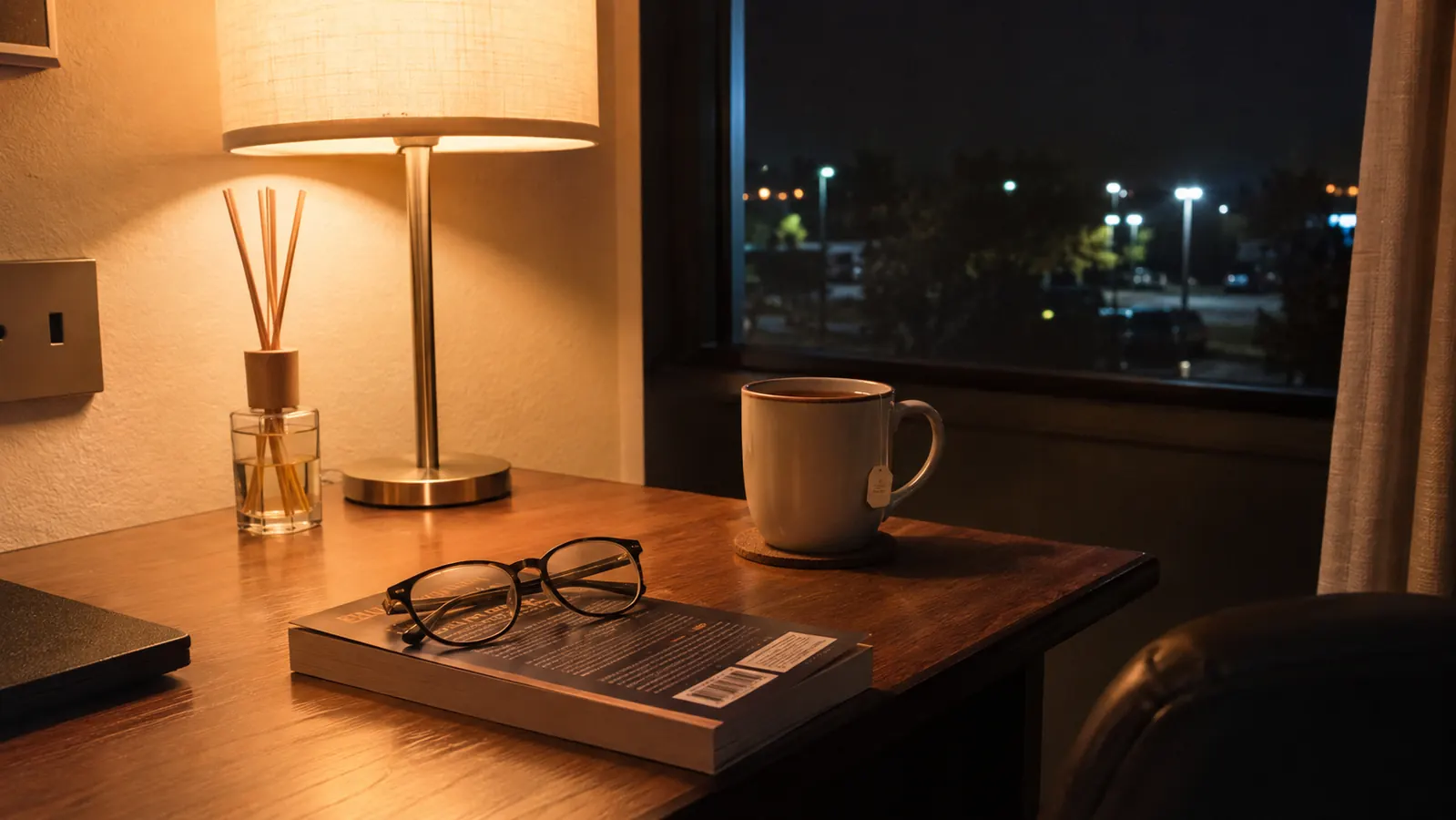
There is a timer setting too, and I use it every night. I sleep lightly in beds that are not mine, and the last thing I want at three in the morning is to be lying there wondering whether the thing on the desk is still running. Set the timer, let it stop on its own, and the scent left in the room carries me to morning.
This is the part where waterless earns its place in my bag. There is no water to spill on a hotel carpet, no cup to rinse in a bathroom sink, nothing to knock over and soak the one paperback I brought. If you have ever traveled with an ultrasonic diffuser you know the small puddle I am describing. I go through the two designs side by side in my comparison of waterless and ultrasonic diffusers, and the short version is that the one that needs no water is the one that travels.
Step 5: Move it to the car for the long days
The car is where this earns its keep. A 2019 Outback on a nine hour drive to the Blue Ridge collects coffee cups, road dust, and a smell I can only describe as warm upholstery. Because the diffuser is cordless, it rides in the cup holder between the front seats with nothing to plug in and no cord to trip over when I reach for the map. It fits with room to spare, and the lid of the console still closes over the rest of the clutter.
On driving days I use the lightest interval and I crack a window. Heavy scent in a small closed space at highway speed is a bad idea, and there is no reason for it. What I want is a car that smells like something I chose, not a car I am sitting inside of like a candle. My rule is simple: if I can smell it clearly with the window up, it is set too high for a moving car. I test at the first stop after an hour and turn it down if I notice it at all.
This is also why two bottles matter. I keep the ambery woody one in the suitcase for rooms and the citrus one in the glove box for the car, so the driving scent and the sleeping scent never blur together. In summer both ride inside with me, because heat is not kind to oils. When I stop for the night, the diffuser comes in and the bottle stays put. I learned that after a July trip when I left a bottle in the console for three days and came back to something closer to furniture polish than to citrus.
What Else Helps
Gear does part of the work. Habits do the rest, and I collected these after more bad nights than I care to count. I open the window for five minutes when I first walk into a room, even in February, because moving air does more than any fragrance. I wipe the remote and the bedside lamp switch with a cloth. I keep the suitcase off the bed and set my shoes by the door. None of it is clever, and all of it helps.
I also walk before bed. A few miles on a trail during the day and one slow loop around the parking lot after dinner does more for my stiff lower back than anything I could pack. In the room I stretch my neck and shoulders for five minutes, drink herbal tea I brought from home, and put the phone face down. I am not making a health claim about any of this and I am not a doctor. I am a retired art teacher who wants to sleep in a room that smells like her own house.
If you want to go further on the device itself, my long term notes on how the URPOWER has held up across repeated trips cover the wear and the battery. For me the decision came down to one sentence: the diffuser that needs no water is the one that ends up in the bag every single time, and the one in the bag is the only one that does any good.
Sleep in a room that smells like you chose it
One small aluminum body, two 20 ml oils, one USB cable, and a battery rated for up to 48 hours on Eco. That is the whole scent kit I travel with now, and it retired every gas station air freshener I used to buy on the way out of town.
Amazon Check Today's Price on Amazon →