
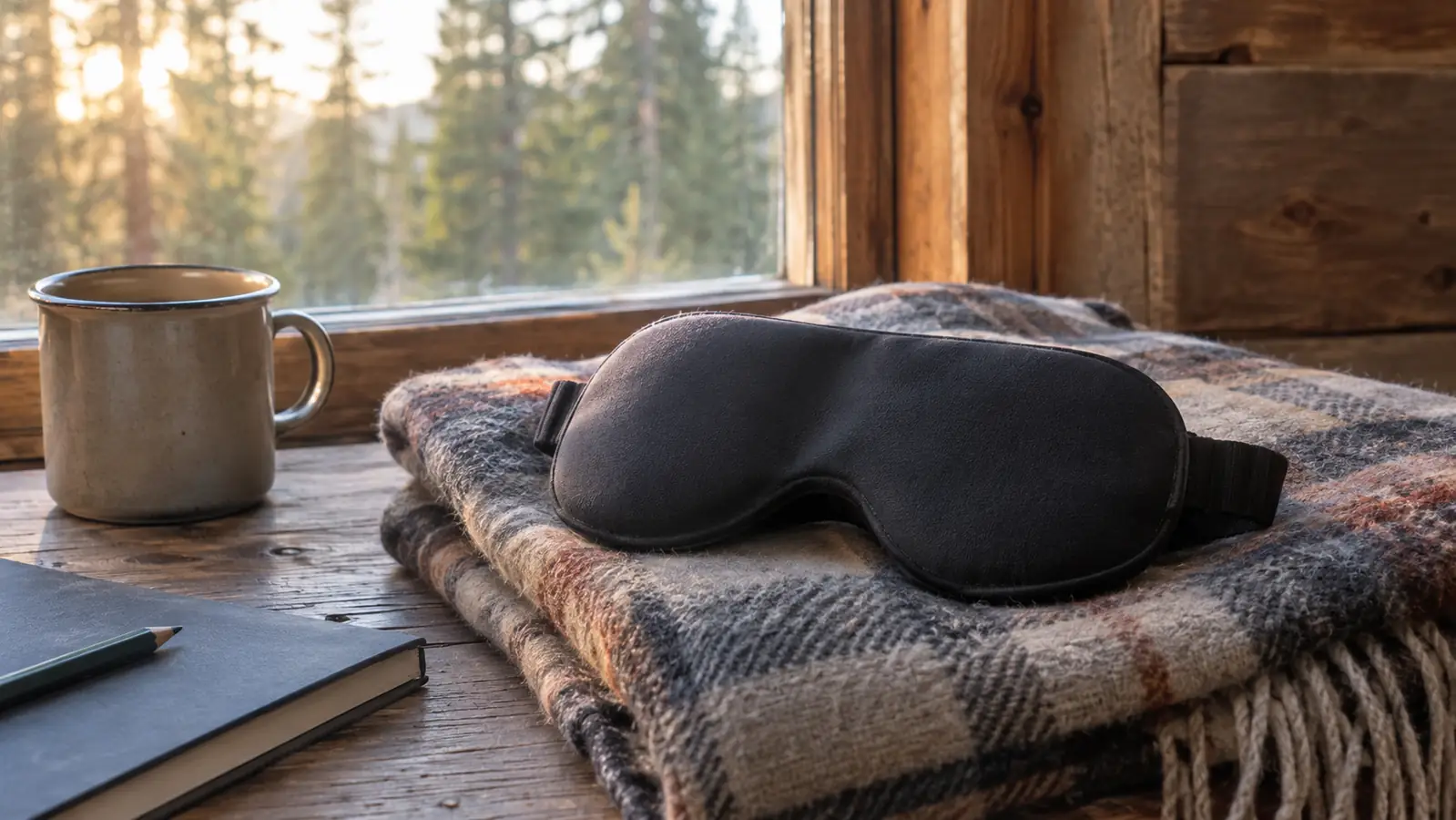
The first night in a strange room tells me almost everything. Motel curtains are a suggestion. A parking lot light finds the gap where the drapes do not quite meet, the clock radio glows, and by two in the morning I am doing arithmetic on how many hours are left before I want to be at a trailhead with a sketchbook. I have folded bandannas into strips, pulled T-shirts over my face, and wedged a fleece against my eyes. All of it ended up on the floor by morning. What stayed put was the MZOO sleep mask, a contoured memory foam mask that now lives in the top pocket of my duffel.
I started using it in the spring, before a three-week run along the Blue Ridge and then west toward New Mexico, and I have now worn it in eleven motels, four campground cabins, and the guest room of my sister's house in Tucson. I am 61, I taught high school art for thirty-one years, and I sleep lightly in any bed that is not mine. This is a plain account of what the mask does, what it does not do, and who it is probably wrong for. MZOO sells a great many of these, more than a hundred thousand ratings sitting at 4.6 stars, and that volume is exactly why I want to be careful. A crowd of good reviews can hide a bad fit.
The Quick Verdict
Blocks light completely and lets me blink and open my eyes with nothing pressing on the lids. Bulky enough that I only pack it when I actually care about sleeping, and hand washing on the road is a small chore.
Amazon Check Today's Price →The mask that survived eleven motels without ending up on the floor
Contoured memory foam cups, a nose bridge cutout that seals without pressing on your breathing, and an adjustable buckle strap that holds all night.
Amazon Check Today's Price on Amazon →How I've Used It
My routine on the road is boring and I like it that way. I get to the room around eight, unpack the car, and set out what I need for the morning so I am not fumbling at five. The mask goes on the nightstand next to a bottle of water and a paperback. I stretch my back for ten minutes on the floor, which does more for the stiffness than anything else I have tried, and then I put the mask on before I turn off the lamp.
The first week I used it, I noticed something I did not expect. I could open my eyes. Every cloth mask I had tried pressed flat against my face, so blinking meant my lashes dragged across the fabric, and opening my eyes meant staring into a dark pocket a fraction of an inch from my eyeballs. The MZOO has cups that arc out over each eye, and the difference is not subtle. I can lie there with my eyes open at three in the morning, which I do more often than I would like, and it feels like being in a dark room instead of being blindfolded.
The second thing I noticed was that it stayed on. I move around a good deal because of my neck, and I had assumed anything that bulky would slide off by midnight. The strap runs through a buckle and stays where I set it. I have not had to readjust it in the night once, which is the whole reason I kept reaching for it after the first trip instead of going back to the bandanna.
I also used it in the driver's seat, which sounds strange. When Walt stays home I stop every couple of hours to walk and stretch, and on a June afternoon on US-54 west of Greensburg I pulled into a rest area with two hundred miles still on the day and wind rocking the Outback. I locked the doors, reclined the seat, put the mask on and slept for forty minutes in the middle of the day. I woke up clear headed instead of groggy. I have done it three times since, in Kansas, Oklahoma and eastern New Mexico, and the difference between those naps and the ones I used to take with a jacket pulled over my head is not a small one. It is not what the mask is sold for, but it is what I use it for.
What the Contoured Cups Actually Change
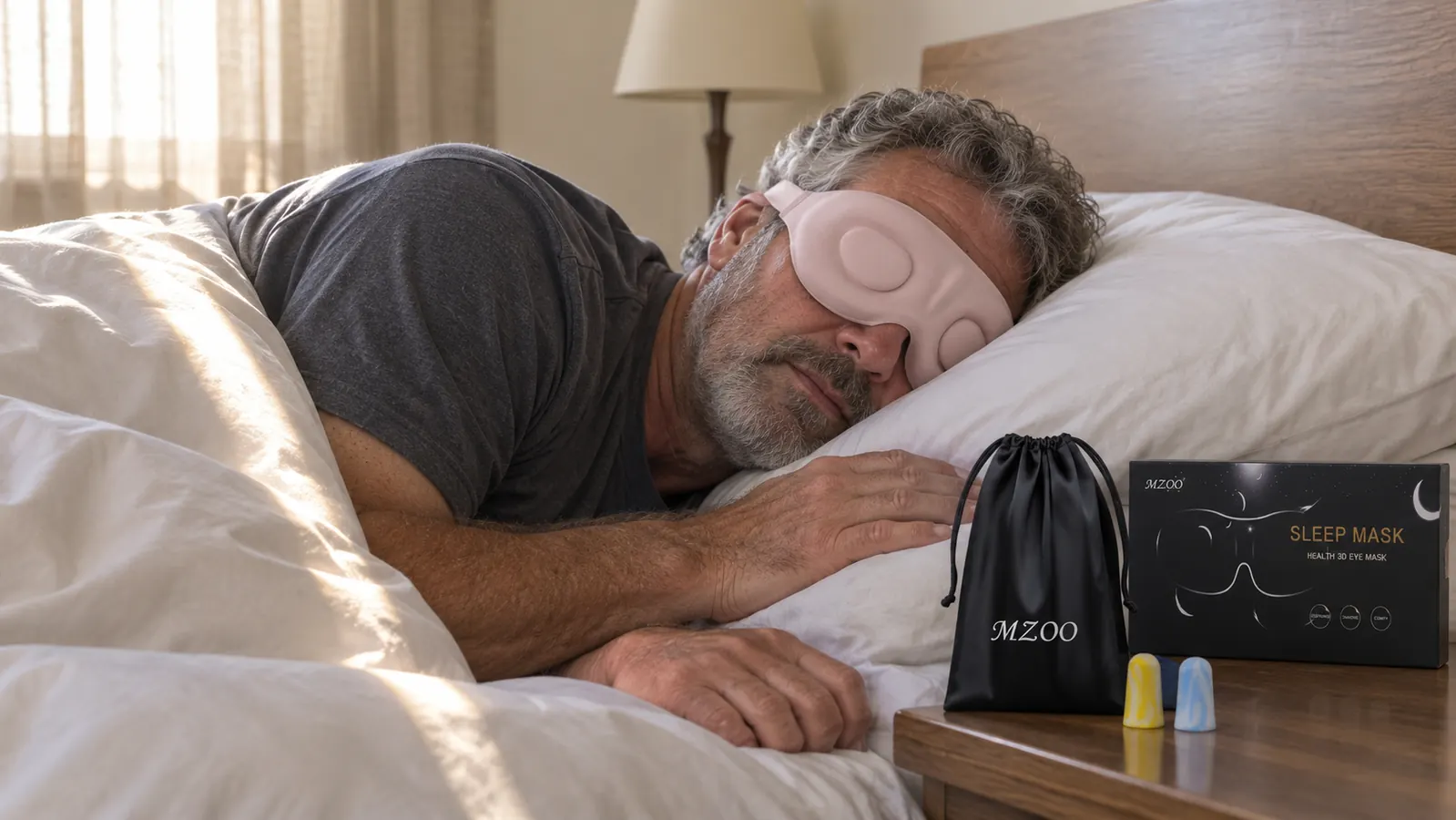
The mask is memory foam with a 3D contoured shape. The eye cups are deepened to 13 millimeters and widened into an arc, which reads like catalog language until you have worn it. What it means in practice is that nothing touches your eyelids. I measured the thing I used to use, out of curiosity, and a folded bandanna comes to about an eighth of an inch of cotton pressed flat across the eye. After six hours it leaves a mark. Thirteen millimeters of clearance is a different order of object. If you have ever taken off a flat mask in the morning with a crease across your cheek and a slightly sore eye socket, you know the problem this is solving.
The light blocking comes from the seal rather than from thickness. The cups sit around each eye and close off at the sides, and there is a patented cutout at the nose bridge so the mask settles down over the bridge instead of resting on top of it. That cutout matters more than I expected. Masks that sit on the bridge let a stripe of light in from below, and they press on the sides of the nose until you are aware of your own breathing. This one breathes freely and the seal still holds.
I tested the seal in the worst room I stayed in, a cabin with a bare floodlight twenty feet from the window and no shade on the glass. With the mask on, I could not tell when the light came on. With it pushed up on my forehead, the room glowed. That is the whole test as far as I am concerned, and it passed.
The cups also leave room around the eyes, which matters if you put anything on your face at night. I do not, but my sister does, and she tried it during a visit and reported that nothing smeared. I mention it because it is the sort of detail that decides whether a mask works for a particular person, and it is not obvious from a photograph of the thing.
I could lie there with my eyes open at three in the morning and it felt like being in a dark room instead of being blindfolded.
Side Sleeping in an Unfamiliar Bed
I sleep on my side, mostly my right, because my lower back complains otherwise. A mask with rigid cups is a problem in that position. The edge digs into the pillow and pushes the whole thing sideways into your face. MZOO curved the sides at fifteen degrees and made them thin so the mask transitions into the pillow instead of catching on it.
In practice, the sides are thin enough that I can press my face into a motel pillow and the mask stays where it is. There is a small bulge where the cup meets the side, but it is not a hard ridge. I noticed it the first two nights and then stopped noticing it, which is the best thing you can say about sleep gear. The hardest test was a cabin outside Ruidoso where the pillows were about the thickness of a folded towel, the worst case for a side sleeper, and the mask did not shift once in six hours. The memory foam softens with body heat and holds its shape rather than flattening out by four in the morning.
The mask weighs just under five ounces, which is not nothing in a duffel you carry into a cabin, but it is light enough that I forget it is in the bag. The adjustable buckle means it fits me, it would fit Walt, who has a considerably larger head, and it would fit my sister, who is smaller than I am. One size with a real adjustment range is the right call for something sold this widely.
One more note on fit. The buckle sits at the back of the head, and if you have long hair or a ponytail you will want to thread it under rather than over. It took me two nights to work that out and after that there was no pressure point at all. Small thing. It is the kind of small thing that decides whether a mask gets worn or forgotten in a drawer.
The Parts I Don't Love
It is hand wash only. That is the honest drawback for anyone traveling the way I travel. I have washed it in motel sinks in Tennessee, Arkansas and twice in the same week in Santa Fe. I use a drop of unscented soap, press it in a towel, and let it dry on the dash of the Outback in the sun. It takes a few hours, and the foam comes back to its shape every time and the strap has not stretched. But the drying is what decides your evening. If I am staying two nights, I wash it the first evening. If you are moving every night, you either wash it late and hope, or you go a couple of nights between washes and know that you are doing that.
It is also bulky compared with a cloth mask. It does not fold into a pocket the way a square of silk does. I carry it loose in the top compartment of the duffel, and it takes up about the space of a pair of folded socks. For the amount of sleep it has bought me, that is a trade I will make every time, but it is a trade.
The foam holds warmth. In an air conditioned room that is pleasant. In a cabin in August with one window and no fan, it is a warm thing strapped to your face, and I took it off one night in Missouri because of it. That was the room, not the mask, but you should know it runs warm.
What It Does Not Fix
A mask blocks light. It does not block the ice machine two doors down, the truck idling in the lot, or a mattress that has been in service since the last century. The ice machine is real. So is the truck at four in the morning in a lot outside Amarillo, which woke me twice in one night with the mask on and working perfectly. I still travel with earplugs and I still do my stretching. The mask solved one specific problem for me and I want to be clear that it is one problem, because the reviews that promise a transformed life are not describing my experience.
It also does not replace the habits. I sleep better on the road when I stop driving by four, walk a couple of miles before dinner, and skip the second cup of coffee at three in the afternoon. The mask is what makes an unfamiliar room dark. The rest is what makes me tired enough to make use of the dark.
The stiffness in my neck and lower back is the reason I wake up at all, and no mask touches that. What helps is ten minutes of stretching before bed, a pillow that is not a few inches too thick, and getting out of the car every couple of hours so I am not arriving at a motel already tight. If you are looking for something to fix your back, this is not it, and I would rather tell you that now than have you find out in a motel in Kansas.
What I Liked
- Blocks light completely, including in rooms with no shade on the window
- Deep contoured cups let you blink and open your eyes with no pressure on the lids
- The nose bridge cutout keeps the seal without pressing on your breathing
- Thin curved sides work for side sleepers and do not catch on a pillow
- Adjustable buckle strap stays where you set it through the night
- Memory foam softens with body heat and holds its shape
Where It Falls Short
- Hand wash only, which is a chore when you change rooms every night
- Bulkier than a cloth or silk mask and does not fold flat
- Runs warm in an uncooled room
- One size fits most, with no smaller option for a very narrow face
Who This Is For
This is for the person who tried a flat cloth mask and gave up on it. If you hate the feeling of fabric resting on your eyelids, if you wake with a crease across your face, if you open your eyes in the night and feel smothered, the contoured shape is the reason to try this one. It is also for side sleepers, who are usually the people a rigid mask punishes worst, and for anyone who sleeps in rooms they do not control. That last group is most of us on the road. I would add one more: anyone sharing a room with a person who reads late or gets up before dawn and reaches for a lamp. Most of the light in a hotel room at night is not coming from outside.
Who Should Skip It
Skip it if what you want is something you can stuff in a jacket pocket and forget. A silk or cotton mask folds flat, weighs almost nothing, washes in a sink and dries in an hour. If your only problem is a little light in a bedroom you know well, that is enough, and it packs smaller. Skip it too if you sleep hot and the room will not be cooled. And if you know yourself well enough to know you will not hand wash anything, be honest about that before you buy, because the foam does not go in a machine.
If a strange room keeps you awake, this is the piece that changed it for me
Memory foam cups that clear your eyes, a nose bridge cutout that seals without pressure, and an adjustable strap that holds until morning. Today's price is on the listing.
Amazon Check Today's Price on Amazon →