
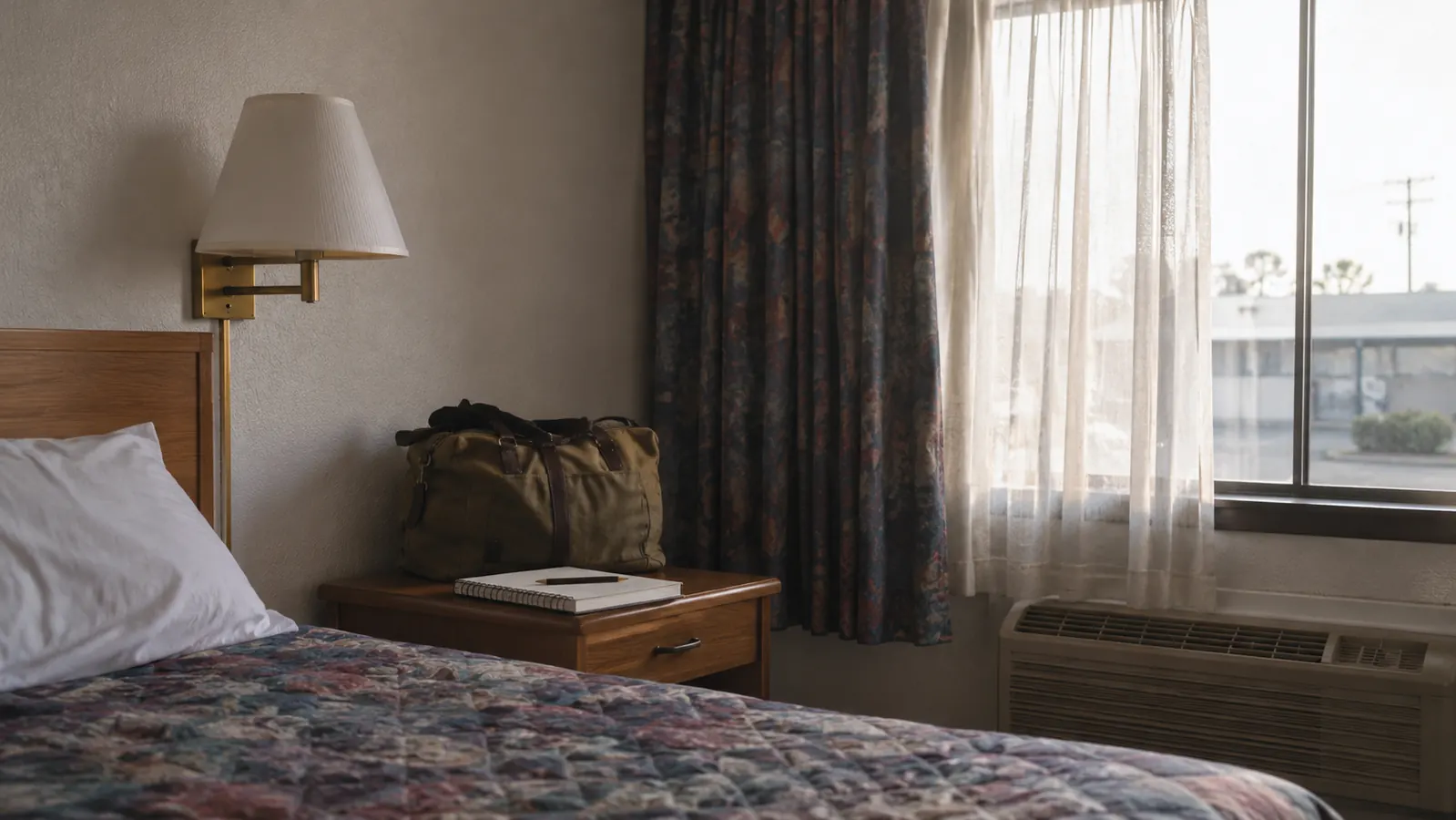
The first night in a strange room is always the worst one for me. It is rarely the mattress. It is the light. A parking lot lamp coming through curtains that do not quite meet, the red numbers on a clock I never asked for, a hallway bulb burning under the door until sunrise. I lie there with my back stiff from six hours in the car and my eyes refusing to stay shut, and by morning I am too tired to paint anything worth keeping.
I have tried the free masks they hand out on planes, and I have tried a folded t-shirt draped over my eyes. What finally worked, and what has lived in the door pocket of my 2019 Subaru Outback for two years now, is the MZOO sleep mask, the contoured one with the eye cups. It is the only mask I have found that shuts out the room and still lets me open my eyes, blink, and roll onto my side without the whole thing pressing into my face. Here is how I actually use it, in five steps, on the road, in rooms I have never slept in before.
The Room Is Not Going to Get Darker. Your Side of It Can.
The MZOO sleep mask is the piece of kit I unpack before anything else in a motel, a cabin or a guest room. Contoured eye cups, a strap I set once, and enough blackout to make a strange room behave like my own.
Amazon Check Today's Price on Amazon →Step 1: Walk the Room Before You Carry a Bag In
Before I take a single bag out of the car, I stand in the doorway and look for light the way I would look for the horizon before starting a sketch. Curtains that overlap by an inch instead of a foot. A gap at the bottom of the door. A television with a standby light the size of a pea that reads like a beacon by two in the morning. A smoke detector with a diode that pulses every thirty seconds, right at eye level, all night, whether I like it or not.
Then I fix what is free to fix. I clip the two curtain panels together with a chip clip that lives in the glove box. I drape a towel over the top of the curtain rod where the light spills over the edge. I unplug the clock and turn the television to face the wall. Ten minutes of that work does more for my night than any pillow upgrade, and it costs nothing but one slow walk around the room with my hands on my hips.
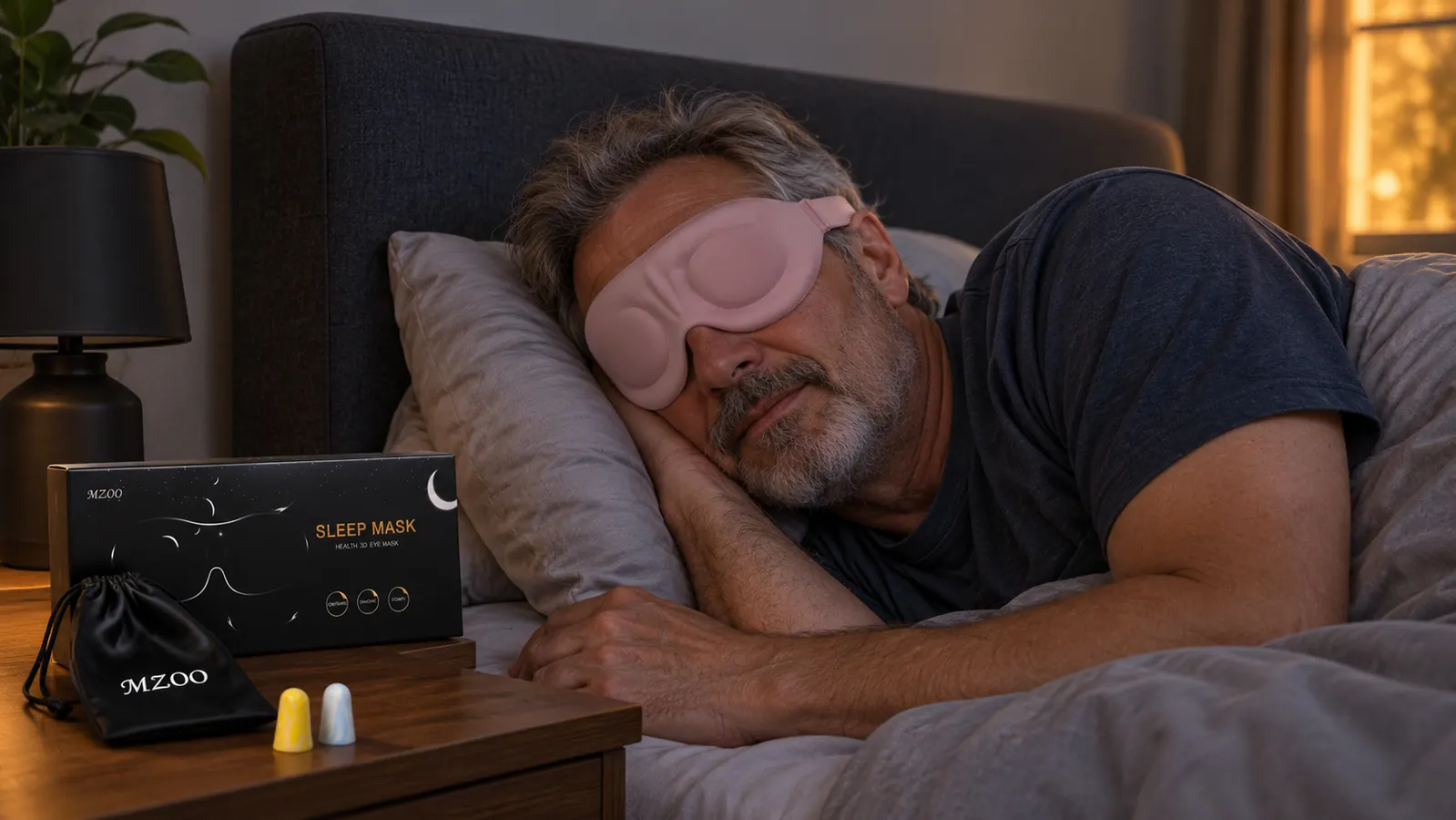
What is left is the part I cannot negotiate with, which is the light coming around the edges of the curtains and under the door. That is the part the mask is for. The MZOO has patented contoured eye cups that seal around each eye rather than resting on the lids, and 22mm of padding under the nose bridge. That nose padding is the detail I care about most, because the nose is exactly where every cheap mask I have owned leaked.
Step 2: Fit the Mask Sitting Up, Not Lying Down
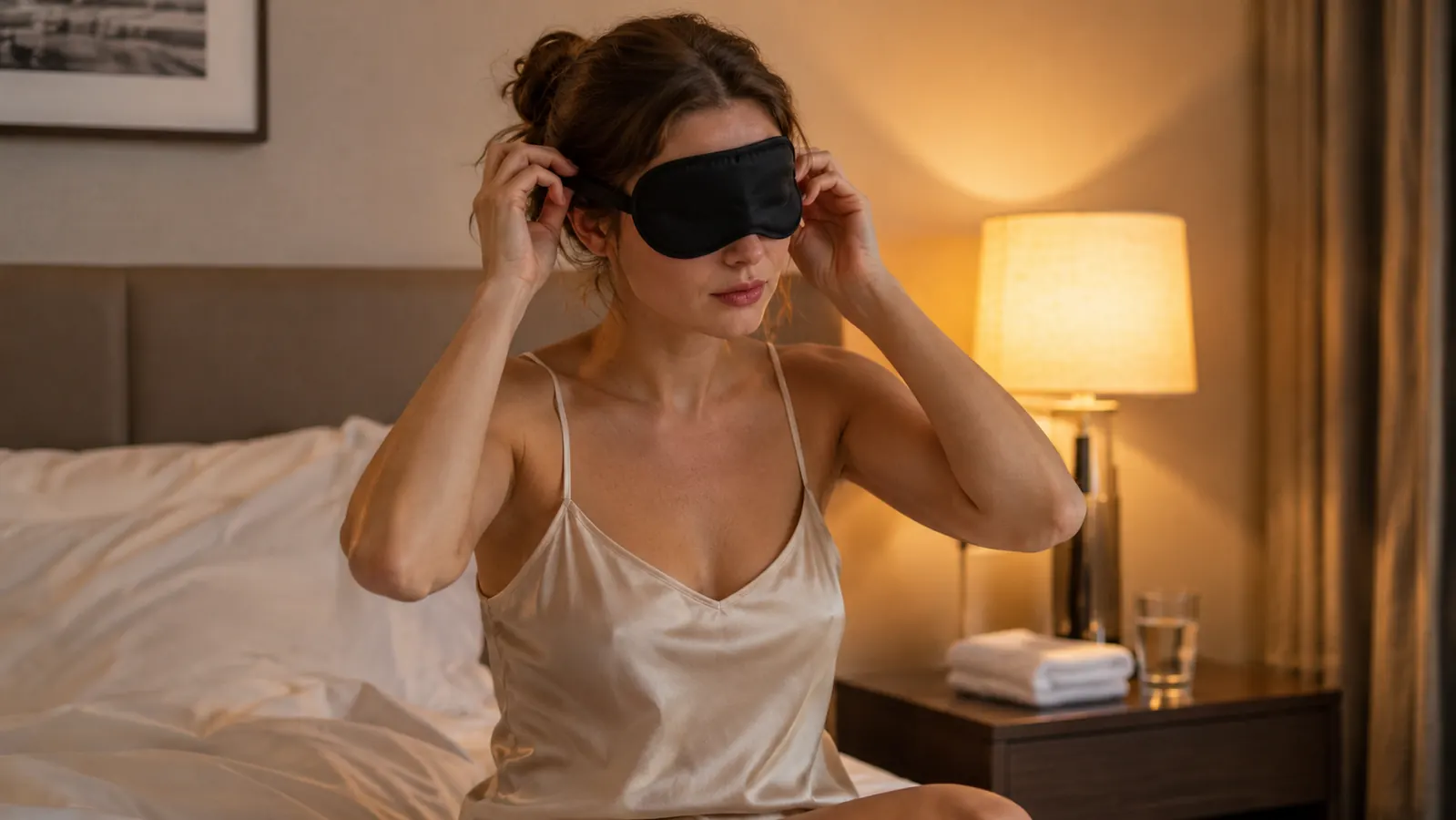
A sleep mask that is too tight will wake you up faster than light will. I learned that in a cabin outside Boone with a strap cinched as far as it would go, and I spent the night feeling my own pulse in my temples. Fit it while you are sitting up, with the lamp still on, before your head touches the pillow.
The MZOO closes with a buckle on an adjustable strap, so I set mine once and then leave it alone. It sits loose enough that I can slide two fingers under the strap at my temple without pulling it away from my face. The mask is memory foam and weighs under five ounces, which is light enough that I forget it is on when I turn over, and firm enough that it holds its shape instead of collapsing against my eyelids.
The small trick is to slide it onto your forehead first, get the strap where you want it, and only then bring the eye cups down over your eyes. Doing it in that order means you are not dragging foam across your face in the dark and then wondering why the seal feels off on one side. It saves a minute of fumbling at eleven at night, which is a minute I would rather spend asleep.
Step 3: Give Your Eyes Room to Move
This is the difference between a contoured mask and a flat one, and it is the reason I stopped buying flat ones. A flat mask presses on your lashes and on the soft skin under your brow, and within twenty minutes you are aware of it. Not in pain. Just aware. Awareness at midnight is the enemy of sleep.
The MZOO has 13mm arc-shaped eye cups, widened so there is real space over each eye. I can open my eyes under it and I can blink. On the nights when I wake at three and my mind starts listing everything I have to do the next day, being able to open my eyes in complete darkness and then close them again is oddly settling. It stops the small claustrophobia that a tight, flat mask creates.
The nose bridge cutout is the other half of that. It sits around the bridge of my nose instead of across it, so I can breathe through my nose freely, and the padding underneath is what stops light coming up through the gap at the bottom. That gap is where almost all light leaks in a mask. Mine does not leak there, and I have tested it in rooms with a lit hallway six feet from the bed.
Step 4: Deal With the Body Before You Deal With the Bed
A mask fixes light. It does nothing for a lower back that has been folded into a car seat since breakfast. I stood at an easel for thirty-one years and my back and neck have opinions about strange mattresses, so the routine is never only the mask.
Twenty minutes before bed I stretch on the floor of the room, which sounds more dramatic than it is. Knees to chest. A slow twist. The one where you lie on your back and let your knees fall to one side and then the other. I walk a few miles most days anyway, and an evening walk in a new town does more for my sleep than anything I could swallow.
I keep the room cool, drink herbal tea instead of anything with caffeine after two in the afternoon, and put a glass of water within reach before the mask goes on. The mask is breathable, which matters in a motel room where a wall unit cycles on and off all night. I have never woken up with a damp face under it, in two years of hot parking lots and cold mountain cabins.
Step 5: Handle the Three A.M. Wake-Up Without Turning On a Light
I wake up in the night in hotels. Almost everyone does. What matters is what you do in the first thirty seconds. If you reach for the phone, you have handed the rest of the night to a screen. If you turn on a lamp to find your water glass, you have told your body it is morning and it will believe you.
So the water goes where my hand falls before I lie down, and the mask stays on. If I wake, I breathe slowly and let my eyes open underneath it, in the dark, and close again. I am a side sleeper, and this mask is built for that. The sides are thin and curved, about fifteen degrees, so there is no bulge pressing into my temple when my face is on the pillow. I turn over two or three times a night and I have never had to re-seat it.
The one piece of upkeep is washing. It is hand wash only, so it does not go in the machine with the rest of the laundry. Once a week on the road I rinse it in cool water with a little mild soap, press it flat in a towel, and let it air dry on the dash of the Outback while I paint. Two years in, the foam still holds its shape and the strap has not stretched.
The nose is where every cheap mask I have owned leaked. The 22mm of padding under the bridge is the reason this one does not.
Test It at Home Before You Trust It on the Road
If you are going to buy a mask, sleep in it at home for a week before you pack it. A strange room is a poor place to discover that the strap sits too high on your head, or that the seal lifts when you turn onto your left side. Work those things out in your own bed, where a bad night costs you nothing but a nap the next afternoon.
I did that with the MZOO. What I learned was that it works better with a cotton pillowcase than a slippery one, and that I want the strap a shade looser than felt right at first. The buckle is easy to nudge once you know where you want it, so the adjustment took me two nights.
Try it for a nap in daylight too, with the room lit and the window wide open. If it blocks a bright afternoon window, it will handle a parking lot lamp at two in the morning without any trouble at all.
What Did Not Work for Me
For the sake of honesty, here is what I tried before this one and why it failed. A silk mask I bought in a museum gift shop was lovely to look at and leaked badly down the side of the nose. A weighted mask felt comforting for about ten minutes and then felt like wearing a warm beanbag on my face, and I could feel my own breath on my cheeks all night. The free mask from an overnight flight did not block the light from a television screen two feet away.
None of those were ruinous mistakes, but each one cost me a night, and a bad night on the road costs me a morning of painting light that will not come back in the same way. That is the arithmetic I use now. I do not choose a mask because it looks nice on a shelf. I choose one that seals at the nose and leaves room over my eyes.
What Else Helps
A few smaller things that have earned a place in the bag, none of which overlap with the mask.
Earplugs. The mask solves light and does nothing about an ice machine down the hall or a truck idling outside at five in the morning. Foam ones are fine and cost almost nothing. A white noise app works too, set going and then left face down with the screen off, so the phone is not lighting the room it is supposed to be quieting.
Your own pillowcase, if you have the room for it. It smells like home, and smell tells your body where it is faster than anything else does. A small notebook and a pencil on the nightstand also help, because the list your brain wants to make at three in the morning gets shorter once it is written down somewhere other than your head.
And the chip clip for the curtains, which is the plainest item in this article and the one I reach for most often.
Guest Rooms Are Their Own Problem
A motel is one kind of problem. A guest room in a family house is another. I spend a week most springs in my sister's spare room in Tucson, where the streetlight comes through a blind that does not close all the way and the hallway light stays on because someone always gets up in the night.
In someone else's house you cannot unplug the clock or drape a towel over the curtain rod without a conversation about it. So the mask does all of the work, and it does it quietly. I put it on when I get into bed, and I am not keeping anyone awake by fiddling with blinds at midnight or taping a shirt over a window.
The same goes for a rented cabin with thin curtains and a porch light that stays on, and for the back of the car if a storm rolls in and I decide not to pitch the tent after all. One small thing that travels flat in a pocket and asks nothing of the room it is in.
The Thing You Will Be Glad to Have at Two in the Morning
Two years, dozens of strange rooms, and the MZOO mask is still the first thing I put in the door pocket of the car and the first thing I look for when I unpack. If you sleep badly away from home, start with the light.
Amazon Check Today's Price on Amazon →