
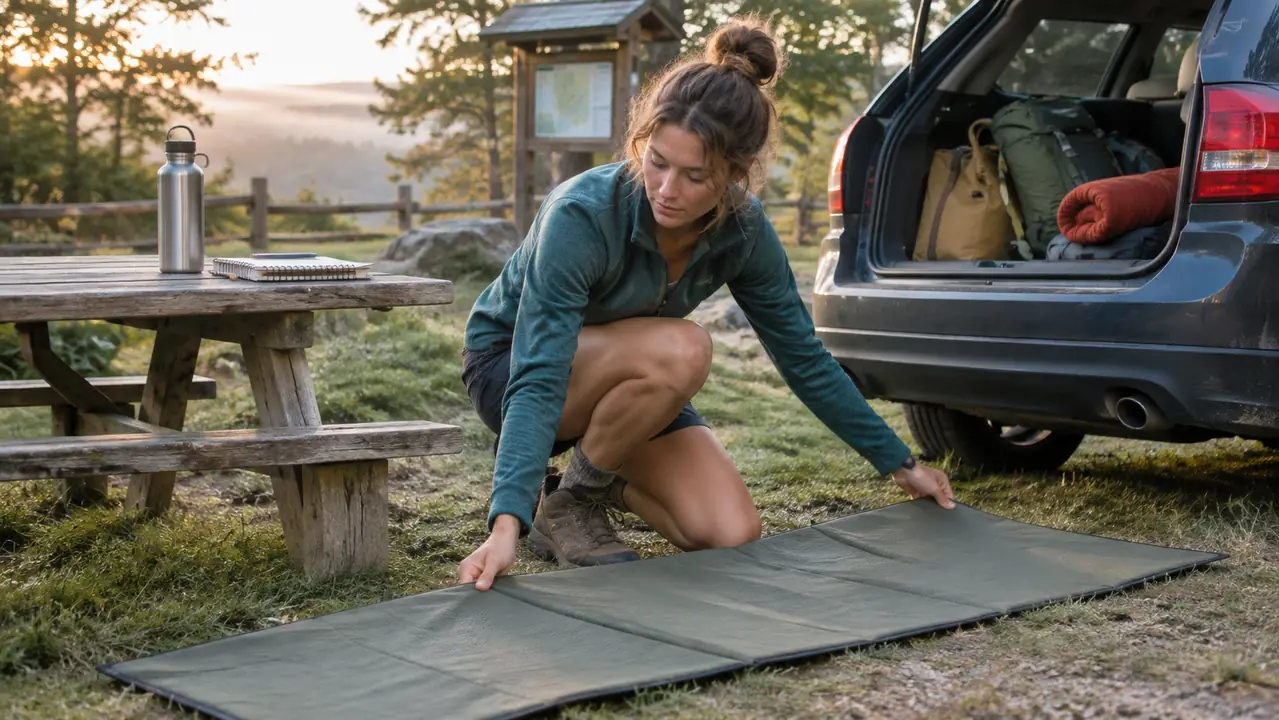
By the time I pull into a campground outside Brevard, my lower back has stopped being a background ache and become the only thing I can think about. Six hours in the driver's seat of my 2019 Subaru Outback will do that. I am 61, I taught high school art for thirty years, and I spent most of those years standing at an easel, so my back and neck have firm opinions about long drives. What has helped most is not a bottle of anything. It is about twelve minutes on the floor with a Gaiam folding travel mat that lives behind the passenger seat.
The mat is 2mm thick, 68 inches long and 24 inches wide, and it folds into a square roughly 10 by 12 inches instead of rolling up. That difference sounds small until you live with it. A rolled mat slides around the back of a wagon and eats the floor space where my water jug sits. A folded one lies flat under the passenger seat or in the seat pocket, and I forget it is there until hour four, when my back reminds me. It weighs 2 pounds, so it comes out of the car with me on a short hike as well. I have written separately about how it has held up over three seasons, and about how it stacks up against the thick mat I keep at home, but what I want to give you here is the routine itself.
Here it is, in the order I actually do it, at a rest stop, in a parking lot, or on the concrete pad beside a picnic table.
The mat I reach for before I reach for anything else
2mm thick, folds to about 10 by 12 inches, 2 pounds. The Gaiam travel mat stays in the car between trips, which is the only reason I use it at all.
Amazon Check Today's Price on Amazon →Step 1: Stop Before Your Back Makes the Decision for You
For two summers I pushed through. I would tell myself the next town was only forty minutes on and that I would stretch when I got there. Then I would arrive, unload the car, and skip the stretching entirely because I was tired and hungry and wanted to find a bathroom. The pattern repeated often enough that I stopped pretending it was going to fix itself. A stop that is not planned does not happen.
Now I plan it. Every two hours or so I take an exit with a gas station, a park, or a trailhead that has a flat patch of ground. Flat matters more than scenic. A sloped overlook pullout makes the whole thing harder and I have given up on them. I park, open the door, and unfold the mat before I do anything else. Not after the coffee. Not after the bathroom. First.
The unfolding takes a few seconds. It comes apart into a flat 68 by 24 inch strip, and I lay it on pavement, on grass, or on concrete. Then I sit down on it and let my shoulders drop. That first sit is not really a stretch. It is a signal, and it has turned out to matter more than I expected.
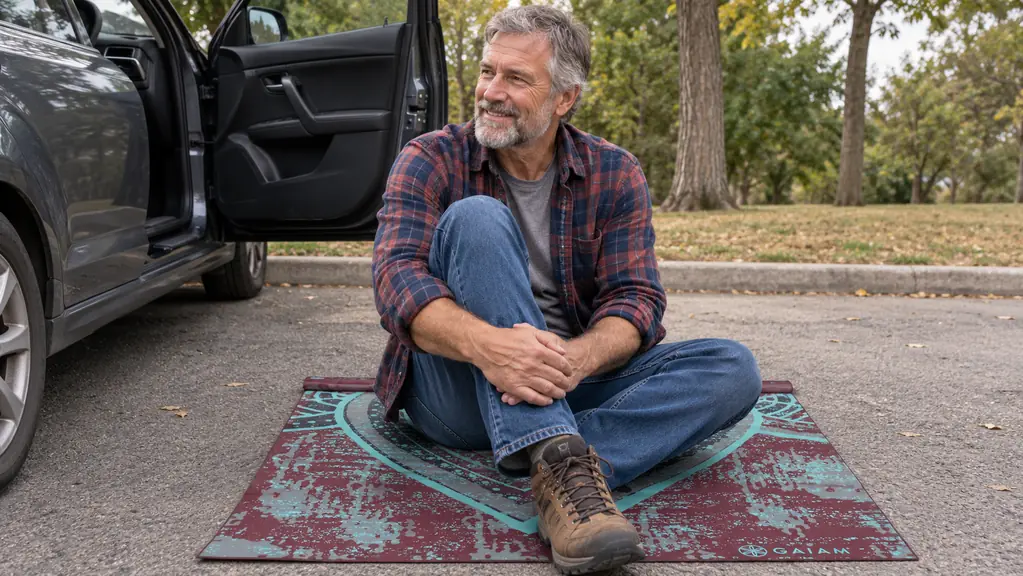
Step 2: Start With Your Back, Not Your Hamstrings
If you only do one thing, do this. Almost everything that bothers me after a long drive sits between my shoulder blades and across my lower back. Not in my legs. So I start there and I stay there for most of the time I have.
I lie back on the mat, draw both knees toward my chest, and hold my shins. I rock a little side to side, which loosens things that a still hold does not. Then I let one knee cross over my body and turn my head the other way, and I stay. Not a count of thirty. Just long enough that the side I am lying on starts to feel heavy and the twist stops being work. Then I switch sides and do the whole thing again.
Two things I have learned about this position on a 2mm mat. First, it is thin enough that I feel the ground underneath me, and I want that, because it tells me where my hips actually are instead of letting me float. Second, on gravel I notice the thinness, so I look for a smoother patch or lay the mat on grass. I fold one end over when I want a little more under a hip.
Step 3: Give Your Hips and Neck Their Own Turn
Once my back has loosened, I move to my hips. Tight hips pull on the lower back, which is why I save them for after and not before. I sit cross-legged on the mat, bring the soles of my feet together, and let my knees fall open. I do not press them down. I let gravity do the work and I breathe out slowly, and after a minute the knees are lower than they were.
Then my neck, which is the part I neglected for years. I sit tall, tip my right ear toward my right shoulder, and stay for a few slow breaths. Then the other side. That is the whole thing. No circling. Circling makes me dizzy, and being dizzy in a gas station parking lot two hundred miles from home is not how I want to spend an afternoon.
The 24 inch width earns its keep here. I have room to sit cross-legged without my knees hanging off the edge onto cold concrete. On a narrower mat that small thing becomes an annoyance, and an annoying stretch is one I quietly stop doing.

Step 4: Hold Longer Than Feels Productive
This is the step I got wrong for years. I used to run through stretches like a checklist, five seconds each, and then wonder why nothing changed between trips. A stretch I hold for five seconds does almost nothing for me. It is long enough to count and not long enough to matter.
What works is a longer hold with an easy breath. I pick one position, usually the knees to chest or the twist, and I stay until I have breathed out slowly eight or ten times. I do not count, because counting makes me rush to the end. I just notice when the position stops feeling like effort and starts feeling like sitting.
If something pinches or feels sharp, I come out of it. That is not a thing to push through. I am 61 and I would like to still be painting at 71, so I have gotten comfortable being conservative about this. The mat is thin, which is the tradeoff, and I would rather fold an end over for padding than tough out a position that hurts.
Step 5: Fold It Up and Do It Again at the Next Stop
I fold the mat back into its 10 by 12 inch square and put it on the passenger seat, not back under it. That is the whole trick. The Gaiam mat is only useful if it is the first thing I see when I get back in the car. Put it out of sight and I will not take it out at the next stop, and there will be a next stop, because the drive is long.
On a full day I do the routine three times. Once in the morning around the two hour mark, once at lunch, and once when I reach wherever I am sleeping. That last one is the one I used to skip and the one that matters most. After a day of driving I am not going to sleep well in a strange bed if I get into it stiff.
I noticed the difference on a drive out through the Blue Ridge last October. I did the routine at every stop, including a cold one in a trailhead lot with the engine still ticking, and I slept through the night twice in a row in a motel bed that would normally have had me up at two. A mat did not fix my sleep. Getting out of the car loose enough to walk a lap around the lot before bed did something, though.
What Else Helps
Stretching is the floor of the routine, not the ceiling. These are the other things I have landed on over several seasons of these drives, roughly in order of how much they matter to me.
I keep a one liter bottle in the door and finish it between stops. Not because water is magic, but because a full bottle is a reason to stop, and stopping is the point. I drink plain water and herbal tea from a thermos. The fountain soda at the gas station makes me feel worse by hour five, and I gave it up two years ago.
Twenty minutes of walking at a stop does more for me than twenty more minutes of sitting still. If there is a park, I take a short loop on a gravel path. My hips loosen on their own when I walk, and I do less work on the mat afterward. When there is nowhere to walk, I do two laps around the building and call it even.
At night I set the room up so that getting out of bed is not a production. Water within reach, my bag on a chair and not on the floor, the temperature a couple of degrees cooler than I keep it at home. I sleep lightly in unfamiliar beds and I have stopped trying to argue with that. Making the middle of the night easier is worth more than any gadget I could buy.
And I keep the mat where I will see it. If it ends up buried under the sketchbook and the folding stool, it may as well still be at home in Asheville. It is the one piece of gear in my car that earns its space by taking up almost none, which is why it comes on every trip and the thick mat stays in the closet.
Walt comes along on one trip a year and does not stretch at all, which I have decided is his business. But he has started walking a lap with me at the lunch stop, and he has stopped complaining about the extra ten minutes. That is about as close to agreement as I am going to get from him.
Twelve minutes on the floor at the end of a six hour drive is the difference between an evening I can use and an evening I spend lying down.
The twelve minutes at the end of a long day
2mm thick, 68 by 24 inches, folds to about 10 by 12 inches and weighs 2 pounds. The Gaiam folding travel mat is the one piece of gear I put back in the car every spring.
Amazon Check Today's Price on Amazon →