
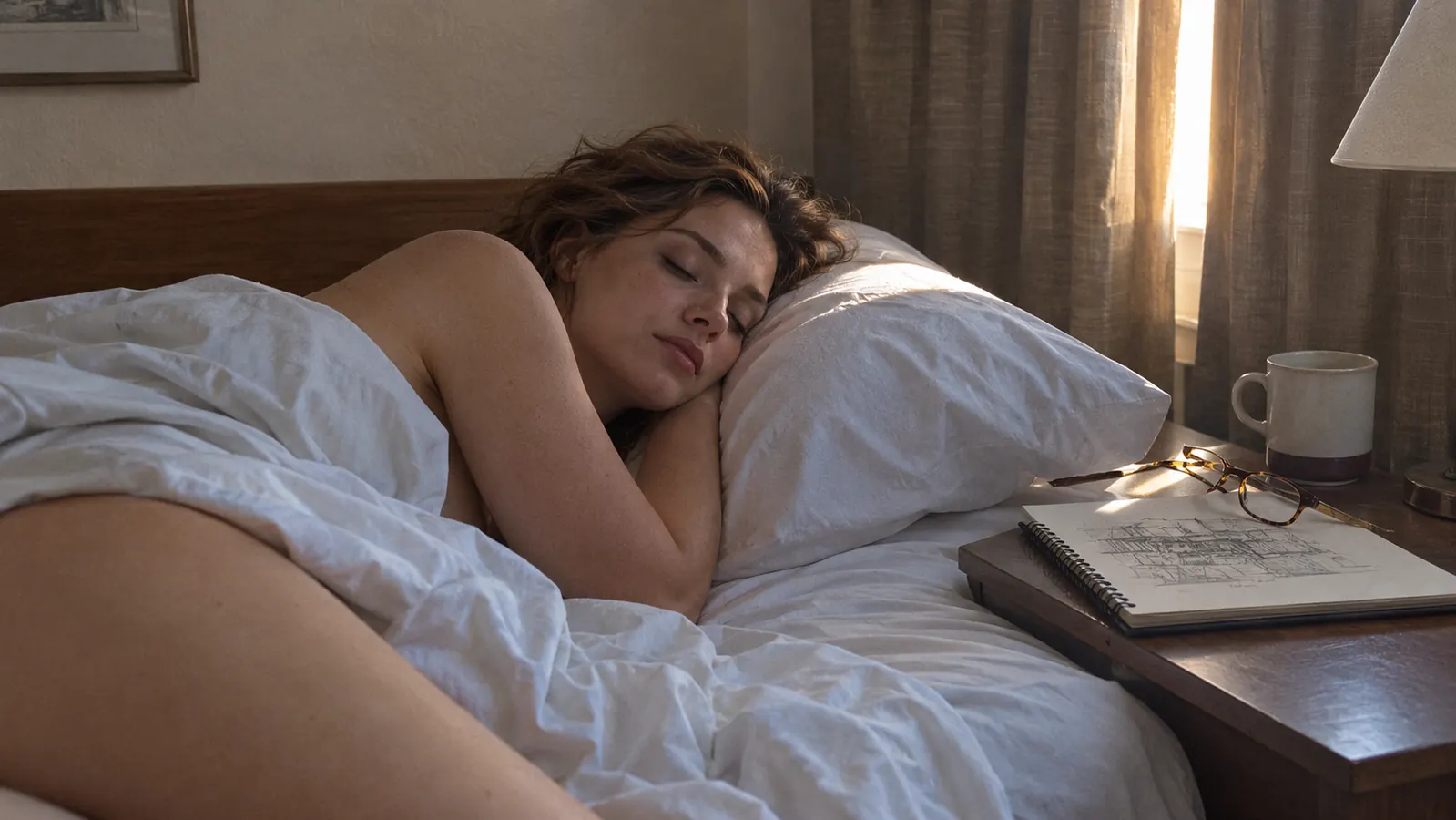
Three nights into a week of painting in the Smokies, I gave up on the hotel curtains. My room faced a parking lot with a floodlight on a pole, and the drape had a gap at the top that dropped a stripe of light directly onto the pillow. I have slept lightly in unfamiliar beds for as long as I can remember, and thirty years of standing at an easel have left my lower back and neck with firm opinions about pillows. So I started carrying a sleep mask the way I carry a water bottle. The one I have used most this year is the MZOO Luxury Sleep Mask, the contoured one with the patented cups, and this is the honest version of what it is like to live with it.
Most reviews of a sleep mask tell you that it blocks light, which is a little like reviewing a thermos by confirming it holds coffee. The useful questions are narrower. Does it press on your eyelids? Does the edge dig into your temple when you roll onto your side? Does it still fit after the strap has been loosened and tightened forty times? Does it survive a hand wash in a motel sink? Those are the things that decide whether a mask ends up in your bag on every trip or in the drawer with the travel alarm clock. So that is what this is about.
The Quick Verdict
Blocks light completely and genuinely keeps weight off the eyes. The tradeoffs are care and warmth: hand wash only, and the memory foam runs hot after a few hours.
Amazon Check Today's Price →If light is what wakes you at 5 a.m., start here
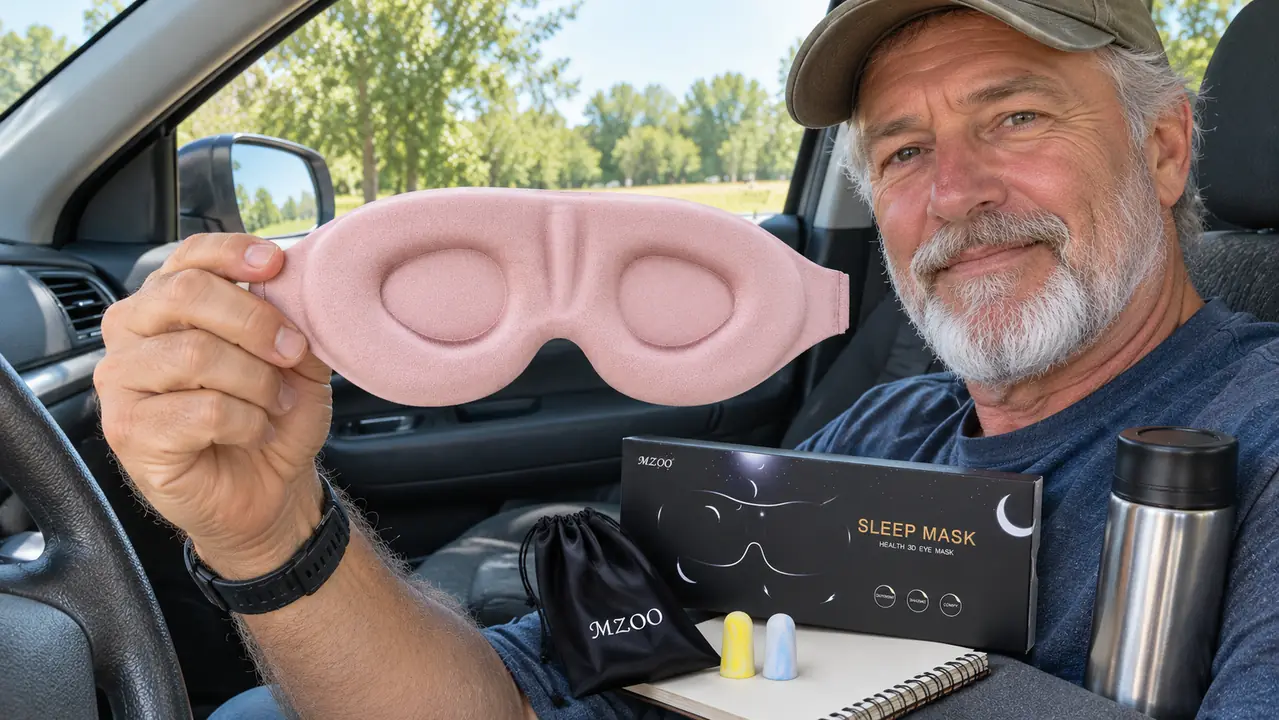
The MZOO is the mask I keep in the car door pocket. Contoured 13mm cups, adjustable buckle strap, just under five ounces, complete blackout.
Amazon Check Today's Price on Amazon →How I've Used It
I bought nothing for this review and I have no relationship with the company. I have used the MZOO on four road trips out of Asheville in my 2019 Subaru Outback, two of them a week or longer, plus a flight to Tucson to see my sister and a long stretch of ordinary nights at home. It has been in cabin bunks, in motels where the blinds do not quite meet, and in my own bed where the problem is less about light and more about a mind that will not settle after a day of looking at a half-finished painting. My husband Walt stays home on most of these trips, so the mask lives in the driver's side door pocket with a folded bandana and a spare hair tie.
The first trip with it was four nights in a state park cabin in Tennessee in April, a small place with a porch and a screen door that let the porch light in all night. My first attempt at that problem was a bandana folded into a strip and tied at the back of my head. It slid up by midnight and I woke with it sitting around my forehead like a sweatband. Night two I draped a spare T-shirt over my eyes. That lasted about an hour before I rolled over and it went onto the floor. On the third night I used the MZOO and it stayed on until the alarm.
The pattern of use matters. I put it on when I get into bed, not in the middle of the night, because the point is to stop the room from giving my eyes things to look at. On the road I am usually asleep within twenty minutes, which was not true before I started wearing something over my eyes. At home I use it less, maybe three nights a week, mostly when I have been sketching late and my brain is still sorting shapes and values.
One thing I did not expect: it is useful in daylight. On the one trip this year that Walt came along, I napped in the passenger seat while he drove a long stretch of I-40, and the mask turned a bright afternoon into something my eyes could actually rest in. I would not have guessed a sleep mask would earn its place in the car rather than the suitcase. On the flight to Tucson in June I put it on as we pushed back from the gate and did not take it off until we started down, and my sister met me at baggage claim and told me I looked like I had actually slept, which she has not said to me in twenty years.
What the Contoured Cups Actually Do
The MZOO has a 13mm arc-shaped, widened eye cup, and the practical version of that number is this: there is space in front of your eyeballs. Nothing rests on your lashes. You can open your eyes, blink, and look around at total darkness, which sounds pointless until you have spent a night in a flat mask that pressed your eyelids shut and left you aware of your own face. If you wear mascara on a trip the space matters more, because the mask is not wiping it across your cheek at three in the morning. I wear very little makeup when I paint, and I notice the roominess anyway. It changes the mask from a bandage into a small dark box you are allowed to be inside.
The light blocking is the part that holds up best. The cups are contoured and they seal around the eye socket rather than lying flat across the bridge of the nose. There is deep padding at the nose, listed at 22mm, and a patented cutout shaped for the nose bridge. What that means in practice is that the usual leak, the bright wedge that sneaks in beside your nose when you lie on your side, does not happen.
What convinced me was a motel outside Knoxville in May, a place with a security light on a pole about fifteen feet from the window. The first night, before I dug the mask out of the bag, I woke at 4:40 and could not get back under. The second night I wore the MZOO and slept until 6:50, which for me on the road is a long night. The seal is what does it. I checked by running a finger around the edge of the nose piece and there was no gap to find, and the padding underneath sits flat against the sides of the nose instead of hovering over it. I turned my head into the pillow the way I normally sleep, and the light was simply gone.
The nose cutout also means you can breathe through your nose without the mask riding up on every exhale. That sounds like a small thing. It stops being small the first time you sleep in a mask that fogs your own breath back at you.
The light stopped being the reason I woke up. By the second night the floodlight outside the window was irrelevant, and by the fourth I had stopped noticing the gap in the drape at all.
The Side Sleeper Claim, Tested
The listing says the sides are curved at 15 degrees and kept thin, so the mask does not create a bulge at the temple when you roll onto your side. I sleep on my left side almost exclusively, which is one reason my neck and I have a complicated relationship. My first two nights with the MZOO were not good. The light blocking worked, but I woke with a line of pressure above my ear because I had the strap too tight. I loosened the buckle by about a finger's width and the third night was fine.
That is the honest version. A contoured mask does not make side sleeping effortless on its own. The geometry helps, and the thin curved side is genuinely thinner than the cup, so there is no hard lump between your cheekbone and the pillow. But the strap tension does the rest, and the strap is adjustable with a buckle, which means you can find the right setting. It also means you can get it wrong. Give it three nights before you decide anything.
What I still notice on my side: the mask is thicker overall than a flat fabric one, so if I bury my face straight into the pillow it presses into my cheek. I have adjusted by sleeping slightly further back on the pillow. That is a real change to how I sleep, not a defect exactly, but nobody mentions it and you should know it going in.
What Nobody Tells You About Wear and Care
It is hand wash only. That is on the listing, and it is the single most irritating thing about the mask. Memory foam does not take kindly to a washing machine, so you are standing at a motel sink with a dab of unscented soap, rinsing, and pressing it between two towels. It takes about five minutes and it needs doing more often than you would guess, because memory foam holds warmth and holds whatever is on your face. On a two-week trip I wash it every three or four days. At home, once a week.
The washing has its own small ritual by now. In a motel sink I run lukewarm water, add a drop of the unscented castile soap I carry for brushes, work it through the foam with my fingertips without wringing, rinse until the water runs clear, and press it flat between two bath towels. Then I set it on the back of a chair or near the air conditioning vent and it is dry in about four hours. I learned the hard way not to leave it balled up in the toiletry bag while damp. It came out smelling like the inside of a shoe and took two washes to come back.
The warmth is the other thing. Memory foam insulates. In a cool room in October in the mountains that is pleasant. In a motel in August with a window unit that cycles on and off, I have taken it off at two in the morning more than once, not because of light but because my face was hot. A flat cotton mask does not have that problem. It also does not block light nearly as well, so it is a trade either way.
The buckle closure sits at the back of the head and holds its setting. Mine has not slipped, though I keep my hair tied back at night, and I can see how it might shift on very smooth hair. The mask weighs just under five ounces, light enough that I forget it is in the toiletry bag and substantial enough that it does not feel flimsy. The pattern is solid with no print, so it reads as a piece of gear rather than a novelty, which I appreciate at sixty-one.
What I Liked
- Blocks light completely, including the gap beside the nose that defeats flat masks
- The 13mm cups keep all pressure off your eyelids and lashes
- Thin, 15 degree curved sides mean no hard edge at the temple when you roll onto your side
- Adjustable buckle strap holds the setting you choose
- Just under five ounces, so it disappears in a bag
Where It Falls Short
- Hand wash only, which means a sink and five minutes every few days on the road
- Memory foam runs warm after a couple of hours in a warm room
- Bulkier than a flat mask, so face-down sleepers will feel it
- The first two nights are an adjustment while you find the strap setting
- Hand washing means it will not wear as long as a cotton mask if you are careless with it
How It Compared to What I Tried Before
Before this I used a flat silk mask, the kind that folds into a pouch. It was comfortable and it weighed nothing, and it blocked maybe two thirds of the light, with a bright seam at the nose that I could never close. The MZOO is a different category of object. It is a small molded thing that sits on your face rather than lying across it. The silk mask is better if you want something you can stuff in a jacket pocket and forget about. The MZOO is better if light is the actual problem and you are willing to wash it by hand.
I took that silk mask on a trip to the Outer Banks two years ago and gave up on it there. The room had a balcony light that came in over the top of the curtain, and the seam at the nose let a bright thread of it through all night. By the third morning I had it pulled down around my neck and I was waking up irritable and slow. That is the trouble with a flat mask: it has to be perfect at the nose or it is not doing the job, and the nose is the hardest place to make perfect.
I also tried a plain padded cotton mask years ago, the free kind from an airline. That one pressed on my eyes, and by morning my lashes had been folded back all night. The difference between that and the contoured cups is the whole reason I kept using the MZOO past the first week. I am not going to pretend a sleep mask fixed my sleep. It removed one specific, measurable annoyance, which is the most you can ask of a piece of gear.
Who This Is For
This is for anyone whose sleep is broken by light they cannot control: a motel with thin curtains, a guest room with a streetlamp outside, a summer sunrise at 5:30 that comes over the top of a blind, a long flight, a nap in a parked car. It is for side sleepers who gave up on masks because the edge cut into their temple. It is for people who do not mind five minutes at a sink every few days. If you travel several times a year and you have ever draped a towel over your eyes and woken up with it on the floor, this is the version of that idea that actually works. For me that is a parking lot floodlight, a cabin with a screen door, and a sunrise that comes over a mountain ridge at an hour nobody should be awake.
Who Should Skip It
Skip it if you sleep on your stomach with your face straight down, because the cups need somewhere to sit and a pillow is not it. Skip it if you want to throw a mask in the wash with the rest of your laundry. Skip it if you run hot at night and you already know that foam against your face will bother you. And skip it if all you need is to dim a room, because a flat, light fabric mask will do that with less fuss and less space in your bag. There is nothing wrong with the MZOO. It is a specific tool for a specific problem, and it is worth saying so plainly.
The version I keep in the car door pocket
Contoured cups, adjustable buckle strap, complete blackout, hand wash only. Four months of trips and it still goes in the bag first.
Amazon Check Today's Price on Amazon →