
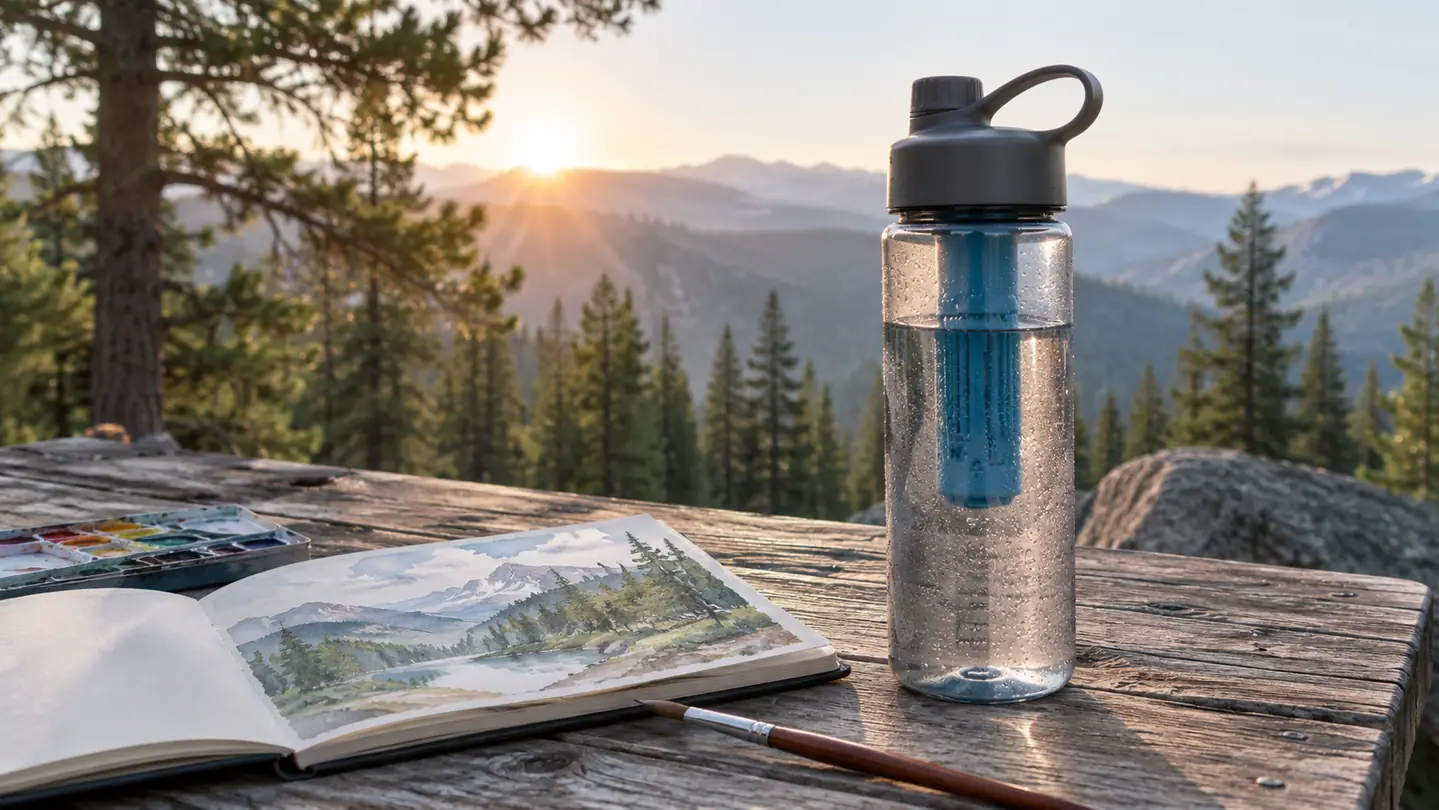
The gas station outside Boone, North Carolina, had one working tap and a handwritten sign taped over the sink saying the water was not for drinking. I filled my bottle anyway, screwed the filter down, and drank the whole liter in the parking lot while the light turned gold over the ridge. That was two summers ago. The LifeStraw Go has lived in my Outback ever since, and my opinion of it is a good deal more complicated now than it was that afternoon.
This is the review I wish I had read before I bought it. Not because the bottle is bad. It has earned its place behind the driver's seat, and I will replace it with the same thing when this one finally gives out. But the marketing around filter bottles, and around LifeStraw in particular, slides past a few things that matter on a long drive. The two filters inside have wildly different lifespans. The bottle does not remove everything a person might want removed. And you will work harder for a mouthful of water than you expect.
The Quick Verdict
A sturdy, genuinely useful filter bottle for tap water you do not trust, held back by a carbon filter that runs out far sooner than the five-year headline suggests and a drinking experience that takes some getting used to.
Amazon Check Today's Price →The bottle that lives in my car, at today's price
One liter, two filters, nothing to charge and nothing to plug in. If you would rather know the limits before you buy than after, you have them. Current price and the full listing are on Amazon.
Amazon Check Today's Price on Amazon →What Nobody Tells You Before You Buy
The first thing is the drinking itself. This is a bottle you drink through, not a bottle you pour from. The water passes through the filter on the way up the straw, which means every mouthful costs you a pull. It is not hard work, exactly, but it is not the loose, absent-minded swig you take from an ordinary bottle either. My first week with it I drank less than I should have, simply because reaching for it took a little more intention. If you are the sort of person who sips constantly while working, you will notice the difference. I remember sitting in the driver's seat in the driveway the day it arrived, testing it before I ever left town, and being surprised at how much of a pull it took to get water moving. My instinct was that something was wrong with it. Nothing was. That is the design. It is worth knowing that the first ten seconds with this bottle feel like a malfunction and are not. Walt laughed at me from the porch when I said so, and he was right to. I have since handed it to two friends who made the same face.
The second thing is what the filter is built for. The listing puts the maximum supported water TDS at 300 ppm, which is a way of saying this is for tap water, park water, hotel sink water, and the like. It is not a desalinator, and it is not meant for a muddy cattle tank. The claims are specific: the membrane microfilter is rated against 99.999999% of bacteria, including E. coli and Salmonella, and 99.999% of parasites. Viruses are not in that list. I am not a chemist and I will not pretend to be one, but I do read labels carefully, and that one is worth reading carefully too.
The third thing is size and weight, which only becomes real when you are carrying it. It stands 11.02 inches tall and about 3.54 inches across, and it weighs 268 grams empty. That is a tall bottle. It fits in the door pocket of the Outback and in the side pocket of my canvas tote. It does not fit in the center console cupholder, and it does not fit in the shallow bottle sleeve on my daypack. I have gotten used to it. But if a bottle has to slot into one specific spot in your life, measure that spot first.
How I've Actually Used It
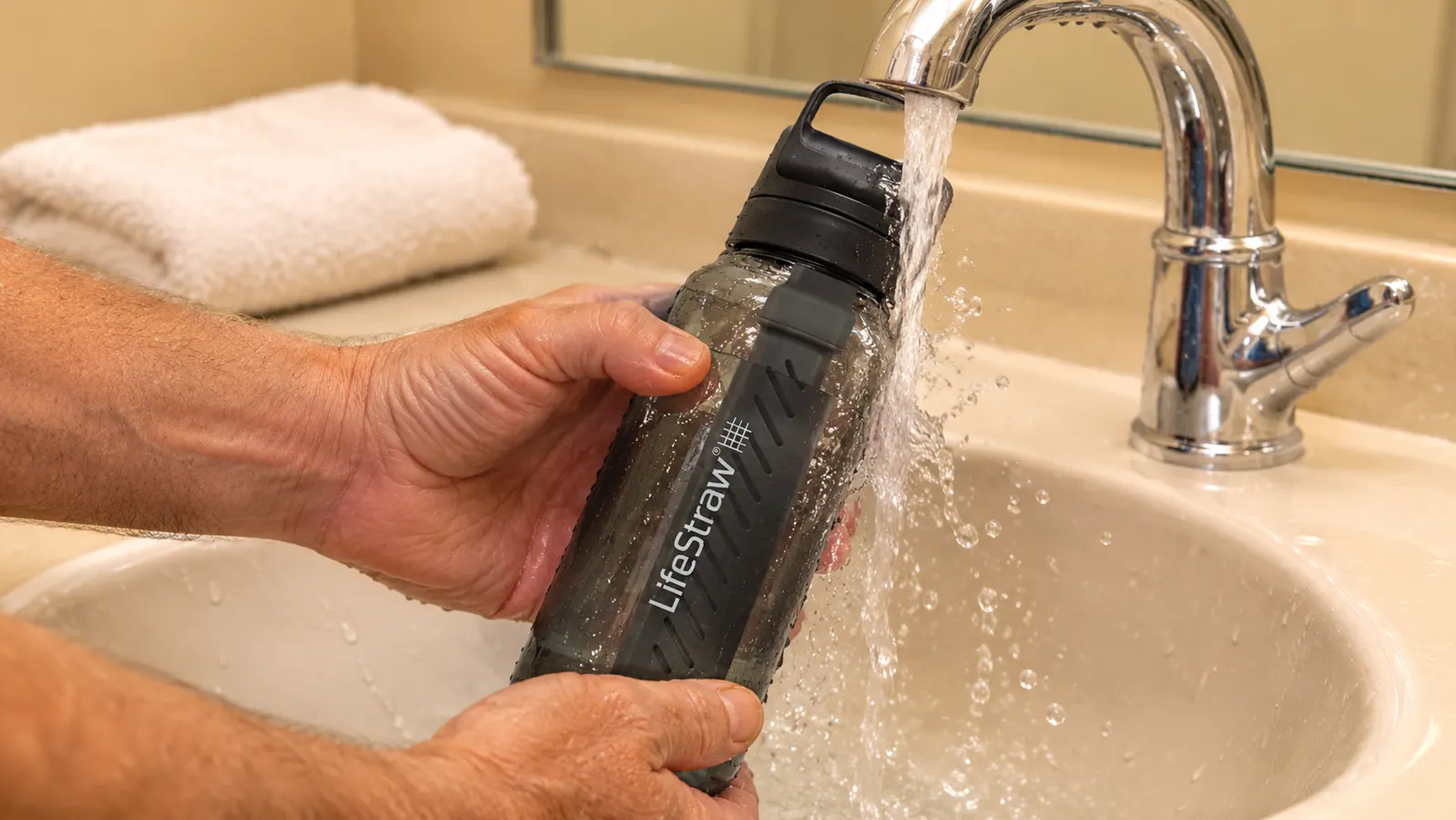
Most of my travel is long road trips to paint. I drive, I stop at overlooks and trailheads, and I stay in whatever small motel is closest to where I want to be at sunrise. The bottle goes where I go. I fill it at the motel sink before I leave in the morning, which is the single most useful thing about it. Hotel bathroom taps are exactly the water supply I have the least faith in, and having a way to fill up without a stop is worth more to me than any line on the label. One October I stayed two nights in a motel outside Fancy Gap, Virginia, where the tap ran warm for the first thirty seconds and smelled faintly of sulfur. I filled the bottle anyway, let the carbon filter do its work, and drank it at an overlook on the Blue Ridge Parkway while the fog came off the valley. It tasted like water. That is the whole endorsement, and it is the one I keep coming back to. Not spring water. Not cold. Just clean and unremarkable, which on a road trip is a small luxury.
It has also been through two airports a year, on the flights out to see my sister in Tucson. Airport bathroom taps. That is the whole story. I fill it after security and I have water for the whole flight without paying airport prices for a plastic bottle I will throw away before I land. On the ground in Arizona, the tap water tastes like the inside of a garden hose, and the carbon filter handles that. It does not make it taste like mountain spring water. It makes it taste like nothing much, which is the goal.
The liter capacity is the quiet advantage. One liter is enough for a morning of painting if I am not gulping, and it means one fill rather than three. I keep it in the passenger footwell with my watercolor block, and I have gotten into the habit of drinking a full liter before I start a session and another after. Standing at an easel for three hours with a stiff back is its own problem. Being dehydrated on top of it makes everything worse, and this bottle is the reason I am not.
It also shrank what I carry. I used to pack a case of bottled water for a week away, which took up the whole back seat floor. Now I take the bottle and a spare carbon filter, and that is the water supply. I still keep one emergency bottle in the car out of old habit, but it has been sitting there unopened for a year. That is the quiet trade: a little more effort per sip, a good deal less stuff.
The Two Filters, and the Number That Surprised Me
Here is the part I most wish had been spelled out for me. The LifeStraw Go has two filters, and they are not on the same schedule. The membrane microfilter is rated for up to 1,000 gallons, which the listing describes as about five years of daily use. Four thousand liters. That is the number on the front of the box, and it is a real number.
The carbon filter is rated for up to 26 gallons. Twenty-six. That is roughly a month of daily use for one person drinking a liter a day, and closer to three weeks if you are drinking more because you are walking a few miles before lunch. The carbon filter is the part that reduces chlorine, odors and organic chemical matter, which is exactly the work that makes questionable tap water taste drinkable. So the part that runs out first is the part that fixes the taste, by a margin of about 974 gallons.
Nobody hid this. It is on the listing if you scroll. But the two numbers sit in different places, and the five-year figure is the one that gets repeated. If you buy this bottle expecting five years of uncomplicated water, you will be disappointed somewhere around week four, when the water starts tasting like the tap again and you cannot work out why. Now you know why. Mine shifted on a Tuesday in June, three and a half weeks in, sitting in the car outside a laundromat in Cherokee. Nothing dramatic. The water just stopped tasting like nothing and started tasting like the sink it came from, and I sat there for a minute trying to work out whether the bottle had gone bad. It had not. The carbon had simply done all the work it was going to do. I swapped in the spare I keep in the glovebox and the next mouthful was neutral again, which told me everything I needed to know about which part had quit.
There is one more number worth knowing. Filter life is measured in gallons of water put through it, not in months on a calendar. If you use the bottle four times a year, the carbon filter will last you years. If you use it every day, you will be buying them regularly. Budget for the version of you that actually exists.
Practically, this means the carbon filter is a consumable you plan for, the way you plan for an oil change. I keep a spare in the glovebox. When the taste shifts, I swap it, and the difference is immediate and obvious. The membrane is the long-term part, and it is the reason the bottle is worth owning at all.
The membrane is rated for 1,000 gallons. The carbon filter is rated for 26. Those two numbers live in different paragraphs, and the gap between them is where most people get surprised.
The Things That Actually Annoy Me
I have four complaints, and I want to be fair about how small they are. The first is the suction. Drinking through a filter takes effort, and there is no way around it. On a hot afternoon at a trailhead, when I want to dump half a bottle down my throat, I have to slow down and pull. It is a small thing that becomes a larger thing when you are tired. I noticed it most on the walk back from a ridge in the Smokies in August, a humid day where I had already drained the bottle once. I wanted to drink fast and the bottle would not let me, so I stood in the shade for a few minutes and pulled a mouthful at a time. It worked. It just added a pause I did not want to take. For what it is worth, I have gotten better at it. Two years of practice and I can drink a liter in about the time it used to take me to drink half, but I still cannot do it while walking uphill.
The second is the tall profile. At 11.02 inches it is taller than the space most bags give a bottle. I have knocked it over at least a dozen times on uneven ground while setting up my easel, because a tall bottle on a slope is a lever waiting to happen. It has not cracked or leaked. But I have learned to set it down flat rather than upright on a rock.
The third is that it is a plastic bottle and it feels like one. The material is listed as plastic and BPA-free, and it does what it needs to do, but it is not insulated and it does not keep water cold. On a July drive through the Blue Ridge, water in the footwell is warm by noon. I have stopped expecting otherwise. If cold water matters to you all day long, this is not the bottle that delivers it.
The fourth is the small daily friction of a bottle that has to be looked after. It is not difficult. But there is a rhythm here that an ordinary bottle does not have, and if you are the kind of person who ignores things until they break, you will end up drinking through a filter that needed attention two weeks ago. That is on you, not on the bottle. It is still worth knowing before you buy.
What I Liked
- Nothing to charge and nothing to plug in. Manual operation, so it works when the power does not.
- One liter of capacity means one fill instead of three on a long morning out.
- Membrane microfilter rated for up to 1,000 gallons, about five years of daily use.
- The carbon filter genuinely fixes the taste of chlorine-heavy motel and airport tap water.
- Fits a car door pocket and a canvas tote, and has survived two years of being knocked around.
Where It Falls Short
- The carbon filter lasts up to 26 gallons, so the taste fix runs out long before the membrane does.
- You drink through the filter, which takes real suction. Not a casual sip.
- No insulation. Water goes warm fast in a hot car.
- 11.02 inches tall, which rules out shallow bottle sleeves and most cupholders.
- Rated to a maximum of 300 ppm TDS and makes no virus claim, so it is a tap and fresh water tool only.
Where It Earned Its Place
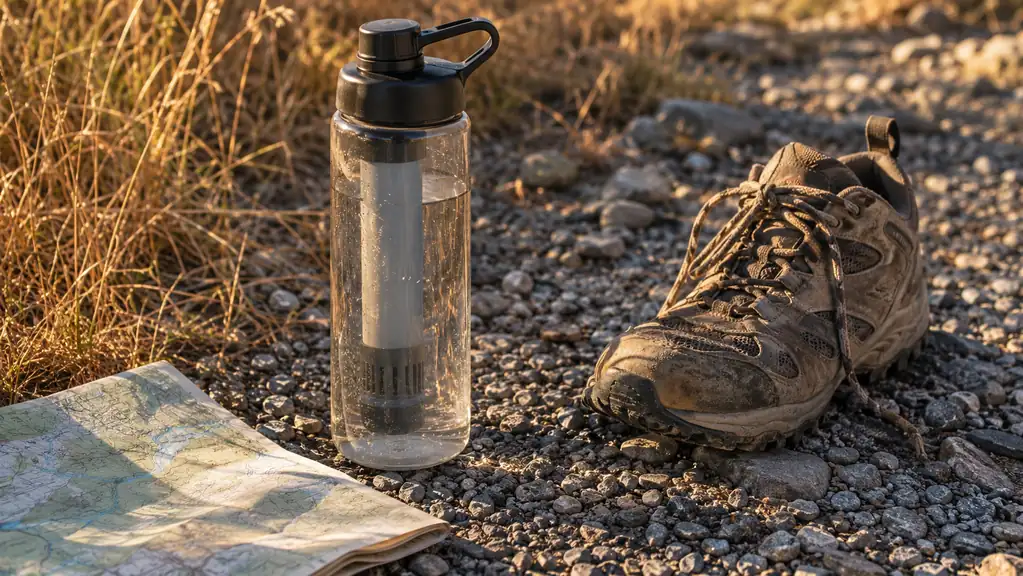
After two years and a lot of miles, the thing I keep coming back to is that the LifeStraw Go removed one specific low-grade worry from my trips. I no longer think about whether the tap in a motel bathroom will taste like a swimming pool, or whether I want to buy another plastic bottle at a gas station. That is not a dramatic benefit. It is a small one that shows up every single day I am away from home, and small daily benefits are the ones that actually change a habit.
The bottle also has not failed me in any way that matters. No leaks in the tote. No cracked body after being dropped on gravel. The manufacturer warranty is listed plainly and I have not had to test it, which is the best thing you can say about a warranty. It looks its age. It works like it did the first month.
Who This Is For
This is for the traveler who drives, stays in ordinary motels and fills up at sinks. It is for someone who wants a liter at a time and does not mind working for it. It suits painters, walkers and anyone who spends a morning outdoors away from a reliable fountain. It also suits the person who is quietly tired of buying bottled water at every stop and wants a simpler habit. If you want a bottle that filters, holds a useful amount, and needs no battery or cable, this is a sensible buy.
Who Should Skip It
Skip it if you want cold water all day. Skip it if you have hand or wrist trouble, because the suction is not trivial and a straw filter is not a kind design for sore joints. Skip it if you are traveling somewhere you genuinely do not trust the water supply at all, since this is a tap water tool and not a backcountry purifier for a questionable source. And skip it if you will not stay on top of the carbon filter, because the bottle is only as good as the part that runs out first.
Two years in the Outback, and I would buy it again
One liter, two filters, no charging cable, and a carbon filter you will replace more often than the box suggests. Today's price and the current listing are on Amazon.
Amazon Check Today's Price on Amazon →