
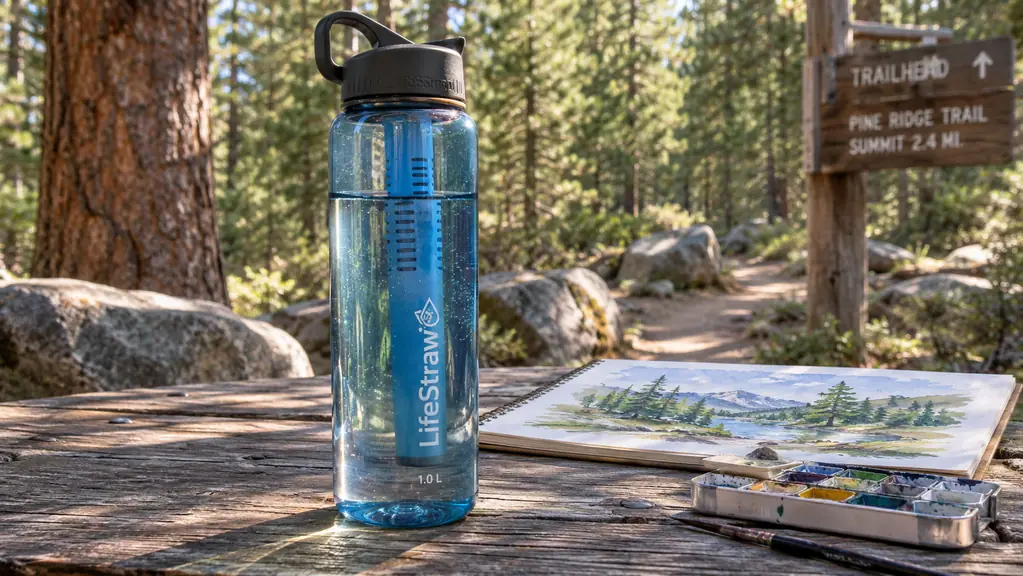
The sign above the sink at the Flaming Gorge rest area said NON-POTABLE in letters faded to a pale orange. I stood there with an empty one liter bottle, four hours of driving ahead of me, and a paper cup I did not trust. I filled the bottle anyway, screwed the lid down tight, and drank through the filter while I walked back to the car. That was the trip where the LifeStraw Go stopped being something I packed for emergencies and became the thing I reach for every morning.
I am Iris, 61, retired from teaching high school art, and I live in Asheville, North Carolina. Most years I take several long road trips in my 2019 Subaru Outback to paint watercolor landscapes at national and state parks, plus a flight or two to visit my sister in Tucson. Thirty years of standing at an easel left me with a stiff lower back and neck, and I sleep lightly in unfamiliar beds, which is a polite way of saying I am fussy about the small things that make a trip feel under control. Water is one of those things. I want it easy, I want it clean, and I do not want to buy it in plastic jugs at every gas station between here and Moab. I have used this LifeStraw bottle for the better part of a year now. Not in a lab. In motel bathrooms, park visitor center taps, campground spigots in Cherokee National Forest, gas station sinks outside Santa Fe, and yes, that rest area near the Utah line.
The Quick Verdict
A one liter bottle with a real filter inside it. It made refilling at doubtful taps a normal habit instead of a daily decision, and it has held up through a year of road trips. The carbon cartridge runs out long before the membrane does, and the bottle is tall enough to be awkward in a cup holder.
Amazon Check Today's Price →The bottle that turned a NON-POTABLE sign into a non-event
One liter, two filters, no batteries, nothing to charge. If you have ever stood at a rest area sink weighing whether to risk it, this is the fix.
Amazon Check Today's Price on Amazon →How I've Used It
My routine on a painting trip is boring, and that is the point. I fill the bottle at the motel sink before I leave in the morning, drink most of it on the drive, and refill at whatever tap I can find near the trailhead. On a long day I go through it three times. That is roughly three liters, and I have not bought bottled water on a road trip since I started carrying it.
The numbers on the listing turn out to matter in ordinary life. The bottle is 11.02 inches tall and 3.54 inches across, and it weighs 268 grams empty. Eleven inches is taller than the cup holder in my Outback is deep, so it leans badly and I gave up on it. It rides in the door pocket or the main compartment of my daypack instead. In the sketch bag it adds a little weight next to the paint tin, which I notice on the first quarter mile of a walk and not after that.
The lid is the part I touch all day. I open it one handed, drink, and close it, and it has not leaked into the bag after a year of being thrown around. I have dropped it on pavement twice. It scuffed both times and kept working.
What changed my behavior was not the filter specs. It was the speed. Refilling is a thirty second stop at a fountain instead of a decision about whether the water is safe. When it is that quick I drink more and carry less. I used to leave the room with two heavy bottles. Now I leave with one and trust the next tap.
What the Two Filters Actually Do
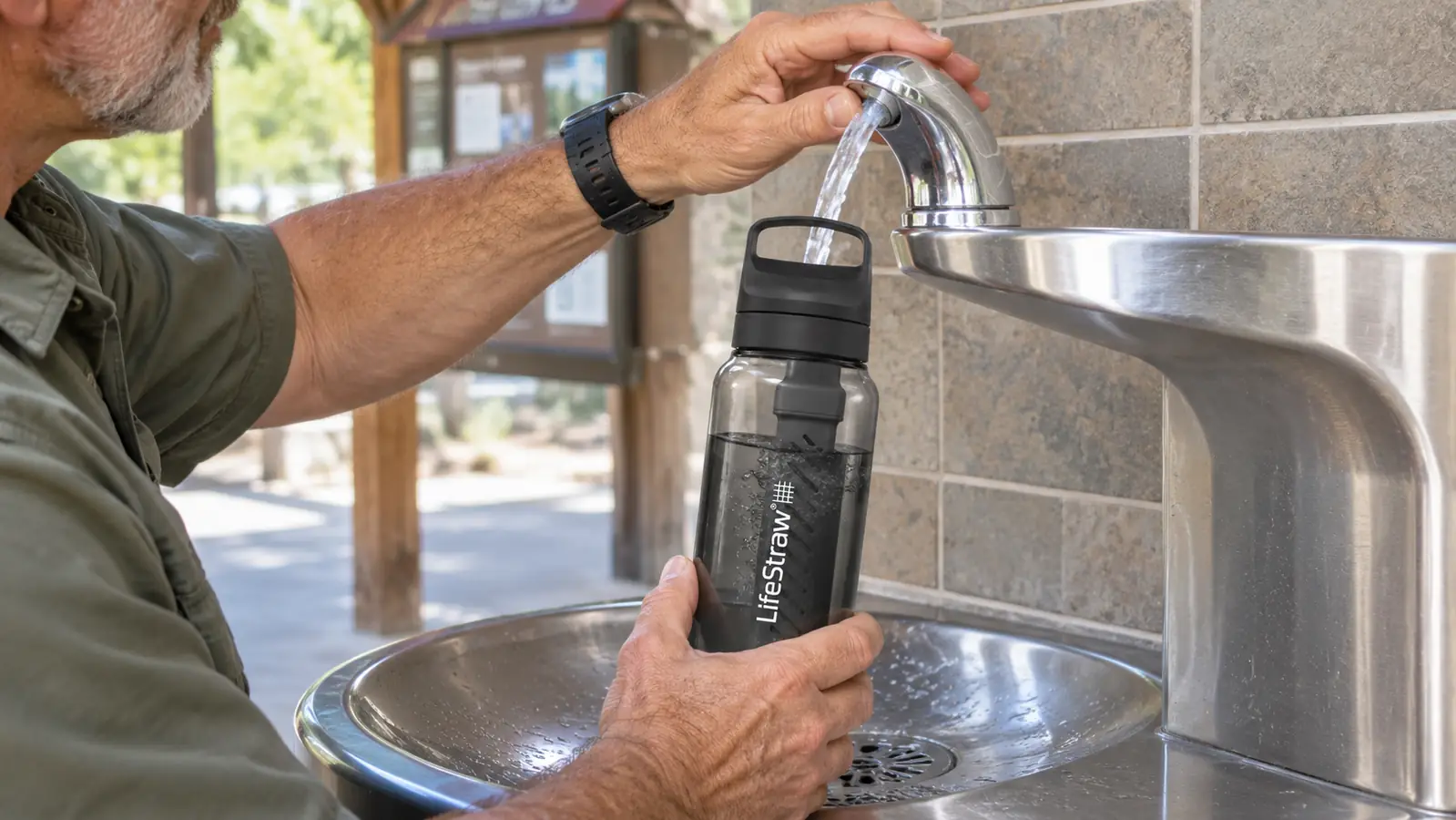
There are two filters in this bottle and they do different jobs. The membrane microfilter handles what you cannot see. The listing rates it at 99.999999% for bacteria, including E. coli and Salmonella, and 99.999% for parasites. The carbon filter handles what you can taste and smell. It reduces chlorine, odors, and organic chemical matter.
That second stage is why this bottle works in a motel bathroom. Municipal water in this country is already treated. What makes it unpleasant at seven in the morning is the chlorine, and the carbon takes that out. I noticed it in the first week. Water out of this bottle tastes like nothing, which is exactly what I want before a long drive.
There is a real limit, and it is worth reading twice. The listing gives a maximum supported TDS of 300 PPM. This is not a tool for brackish water, a mineral heavy well, or anything with a genuine salt load. It is a bacterial and chlorine filter with an ultra filtration membrane, not a desalinator, and no bottle this size is one. If you are filling from a tap, a fountain, or a park spigot, you are well inside the range it was built for. If you are scooping from a stock tank, you want something else entirely.
I also want to be clear about what it has not done for me. It has not turned bad water into good water. It has made ordinary treated water taste like water again, and it has made me willing to drink from taps I would previously have skipped. That is the honest scope of it.
Two Filters, Two Very Different Clocks
The membrane microfilter is rated for up to 1,000 gallons, or 4,000 liters, which the listing describes as about five years of daily use. The carbon filter is rated for up to 26 gallons. Those two numbers are not close, and that gap is the single most practical thing to understand before you buy.
Twenty six gallons is roughly 98 liters. If you refill a one liter bottle three times a day on a trip, you are swapping the carbon cartridge about once a month of hard use. The membrane keeps going for years. So the rhythm of owning this bottle is one small recurring replacement and one five year replacement that almost never arrives.
There is no battery and nothing to charge. The listing gives the power source as manual, which is a long way of saying your mouth does the work. On a road trip I like that. I already carry a phone, a camera, and a headlamp, and I do not want another cable in a motel room with two outlets behind the nightstand.
The odd part is that the carbon swap sneaks up on you. I noticed because the water started tasting faintly of the tap again, not because anything tapped me on the shoulder. If you are the sort of person who keeps a note in the glovebox, this is a good thing to write on it.
Where It Falls Short
It does not insulate. Water takes on whatever temperature the car is, so on a July drive through southern Utah it is warm by ten in the morning. I fill it with ice at the motel when the machine is working and accept it when it is not. If cold water all day is the whole point for you, this is the wrong bottle.
It is also tall. Eleven inches does not go in the cup holder of my Outback and does not fit the side pocket of my smaller daypack. It goes in the door or the main compartment, and it leans over when the car turns. Filling it in a shallow sink at a gas station is a two hand job.
Drinking takes suction. This is not a bottle you pour from. On a hot afternoon after a climb I notice the effort. It is a small thing, but if you want water to move fast, look elsewhere.
Cleaning takes a few minutes at the end of a trip. The listing describes the material as plastic, and a plastic bottle wants to be rinsed and dried with the lid off or it develops that closed up smell. I do it every time I get home and sometimes in the middle of a long trip. A bottle you forget to dry is a bottle you quietly stop using.
And then there are the two filter clocks, which I would rather not think about and have to anyway. If you are the kind of person who will not keep up with a cartridge, buy something simpler and be honest with yourself about it.

What I Compared It To Before Buying
I looked at three options first. One was a filter bottle with a pump or a squeeze bag, which I ruled out because I wanted one piece of gear and not a kit with hoses to lose. Another was a plain insulated bottle plus a filter pitcher kept at the motel, which works beautifully if you stay in one place for a week and fails completely when you move every night.
The third was buying bottled water, which is what I did for years. I wrote the comparison out in my head on a drive through Nevada: two bottles a day, a cooler, a back seat full of empties, and a stop that never lands where you actually want to stop. The LifeStraw bottle moved that stop to the next drinking fountain, which is usually closer than the next store.
What I gave up in the swap is cold water and the certainty of a sealed factory bottle. What I got is a bottle I refill without thinking about it. For the way I travel, one overnight stop at a time, that trade has been worth it. If you stay put for a week, a pitcher or a gravity filter makes more sense and asks less of you.
There is also the surface water question. This is not a backcountry purifier for a silty creek and I do not treat it as one. On the trail I carry it for the tap at the trailhead and the fountain at the visitor center. That is the job it does well, and I would not stretch it further than that.
What I Liked
- Filters a liter at a time with no batteries, cables, or pumping
- The carbon stage removes the chlorine taste that makes motel tap water hard to drink
- Membrane rated for up to 1,000 gallons, which the listing puts at about five years of daily use
- 268 grams empty, light enough to live in a sketch bag without complaint
- Made refilling at rest areas, park spigots, and visitor center fountains an ordinary habit
Where It Falls Short
- Carbon cartridge is rated for only 26 gallons, so it needs replacing far more often than the membrane
- Does not insulate, so the water follows the temperature of the car
- 11.02 inches tall, which is awkward in a cup holder or a small pack pocket
- Maximum supported TDS of 300 PPM, so no help with salty or mineral heavy sources
- Drinking takes real suction, which you notice on a hot afternoon
The carbon cartridge is rated for 26 gallons. The membrane is rated for 1,000. One is a monthly habit and the other is a five year purchase, and knowing which is which is most of what you need to know about owning this bottle.
Who This Is For
This bottle suits the traveler who moves every day and fills from taps, not creeks. If your trip is a string of motels, visitor centers, campground spigots and gas stations, the LifeStraw Go turns all of those into water stops and takes the plastic jugs out of your back seat. It suits people who want one object instead of a kit, and who would rather drink through a filter than plan around a store.
It also suits anyone with a bad back or a fussy sleep schedule who is trying to remove small frictions from a trip. Carrying one bottle instead of two, and not hunting for a cooler, is a small weight off a long day. That sounds trivial until you have done it for a week.
Who Should Skip It
Skip it if cold water is non negotiable. Skip it if you need to draw from ponds, creeks, or anything with a real salt or mineral load, because it is not built for that. Skip it if your cup holder is shallow and your patience for a bottle that leans is thin, or if you want to carry the least possible weight in a daypack on a long hike.
And skip it if you know you will not keep up with a cartridge. The carbon stage is rated for 26 gallons and it will quietly stop doing its job if you ignore it. A simpler bottle you actually maintain beats a filtered one you do not.
If you have a road trip calendar, this belongs on the packing list
One liter, two filters, nothing to charge. Fill it at the motel sink in the morning and stop thinking about water until the next tap.
Amazon Check Today's Price on Amazon →